Wildlife of The Okavango
First let me begin with apologies to everyone reading this blog for my misinforming you on several occasions about the name of the river which runs through Maun. Be pleased to know that it is the Thamalakane river and shares it’s name with the Thamalakane fault line along which it flows in a roughly NE,SW direction. The Thamalakene is fed by three rivers the southern most of which is the Boro. These all flow out of the Okavango Delta. South of Maun the Thamalakane river divides into the Boteti and Nahabe Rivers. The Nahabe flows southwest towards Sehitwa and is joined by the Whanx river and they both flow into Lake Ngami with Sehitwa on it’s shores.
Julia will be having her own very special wildlife experience. Julia has been spirited away to the ‘camps’ where she will be treating camp staff with homoeopathy. The camps belong to a group called Sanctuary and their personell officer, Mary, has been liaissing with Solly the MD of Itekanele health insurance to get us up to the camps. This is great news for the Maun Homoeopathy Project as it means the charity will be paid a monthly retainer to treat the staff at Sanctuary Safari Camps whether they tutn up for treatment or not. It’s good for us homoeopaths too as it means we each get a trip out to these places toeards the end of our terms in Botswana.
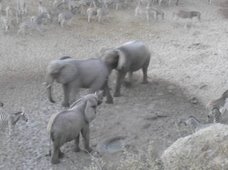
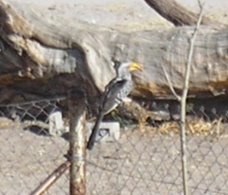
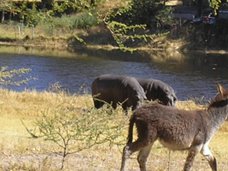
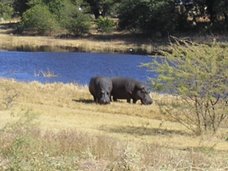
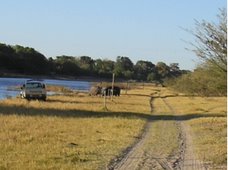
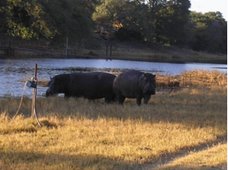
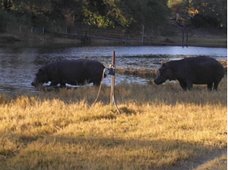
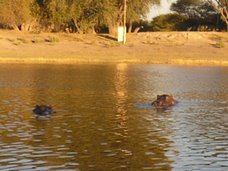
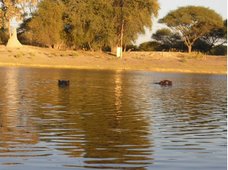
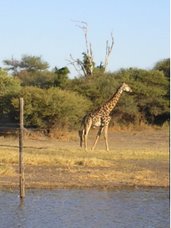
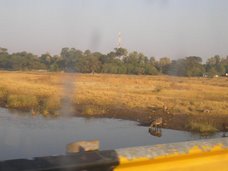
I’ve really been enjoying the wildlife here. Once again I must apologise for misnaming a Lilac Breasted Roller as a Lilac Breasted Rocker. Easy mistake to make. I was also lucky enough to see a Raquet Tailed Roller on the road up from the Thamalakane River just before the turn off for Francistown. So, my wildlife log so far, in chronological order is…Goats, Brahmin Cattle, Donkeys, Horses, Pied Kingfishers, Girraffes, Zebras, Warthogs, Wildebeest, Impala (not Kudu as I have probably misinformed you before), Hippopotami, Fish Eagles, Sacred Ibis, Lilac Breasted Roller, Blue Waxbills, Yellowbilled & Bradfields Hornbills, Hammerkop, Bearded Woodpecker, Yellowbilled & Yellowbilled Oxpecker, Hoopoe, Grey Lourie.
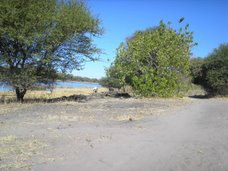
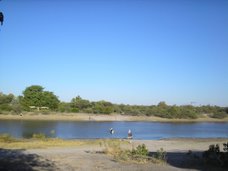
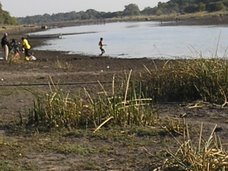
I can also identify a Mopane tree. Anne and I are determined not to be left out of the wildlife experience stakes. Last night 07/07/07 we went for a walk to the Old Wooden Bridge which crosses the river just before Old Bridge. This is a good long walk. If you begin on the southern Disaneg bank you have an interesting walk as there are now about 3 new makorro ferries to tak you across. They were not there when I made my first walk in this direction about a week ago. Now the river is much higher and is beginning to eat into the vehicle track which runs towards Maun town.
If uou begin on the disaneng bank you meet, after about half an hours walking fences and bushes which mark the bopundaries of someone’sland. These are impassable and meen that you have to turn south towards the new road which is being built through disanengand loop round the fenced in land. Once you have found your way back through the sage brush ( for that is what it is, many many yellow green sage bushes interspersed with Mopane trees and others) around the houses and down to theriverbank you continue along in the gentle evening sun. Eventually the bank in front of you curves west and appears to meet the northern Sedia bank. This feels a bit disorienting the first time you do it as it feels as if you have simply walked along the banks of a canal. If you follow the bank round and double back on yourself you realize thet you have followed a U shape down one arrm, along the base and up the other. So, now you’re standing at the top of the right arm of the U. The river flows down past this arm and you can now see the Sedia bank clearly and tou realize that you are still on the Disaneng bank.
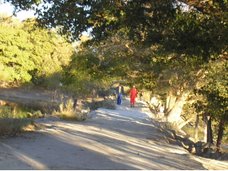
Up river about 100 yards away is the ould wooden bridge which is a very beautiful spot. It is constructed from concrete and treetrunks laid over short sections of concrete pipe through which the river flows and it’s pillars are large live trees which povide an avenue of welcome shade to anyone crossing the bridge. If you cross the bridge from Disaneng bank towards the Sedia road bank you can walk back along this bank by walking along a road through a neighbourhood and then turning left down the alley between two compounds back onto the riverbank.
Walking the river along the Sedia road bank is muchquicker than on the Disaneng bank as one does not need to curve away from it at any point, nor negotiate small game trails gthrough thorny bushes. However, last night Anneand I decided to walk towards the bridge along this route and back along the Disaneng bank towards home.
We walked some of the way to the bridge along the Disaneng bank because we wanted to cross to the Sedia side by one of the other Makorro ferries. Captain Small Makorro is very very busy al day it appears. About 100 yerds up is Mma Makorro, so called because it is run by a venerable old lady further on there is Rootsy Makorro, so called because it is a fibreglass boat but in the shape of a traditionl wooden makorro and has no seats. Like Captain Small Makorro and Small Boy Makorro, Rootsy Makorro is punted back and forth by a small boy who pole vaults onto shore from the back of the boat to haul the boat in. After Rootsy Makorro is Small Boy Makorro and then Cattle Makorro. There is also Bridge Makorro at the bridge.
We chose Rootsy Makorro because he doesn't’t seem to get half as much trade as Captain Small Makorro. Also Mma Makorro was not around. But in future I think we will stick with rootsy. We passed small-boy-Makorro and Cattle Makorro and walked along the vehicle tracks in the sage brush. We were passed by a man teaching his son to ride his bike. The man had a broom jammed down through the forks behind the saddle down to that bit where the pedals are attached and was jogging along acting as a sort of stabiliser. They also had 3 dogs with them. Two spaniel type things and one Boer Bull type dog. All 3 were chasing birds. The Boer Bull actually ran into the river and began swimming in pursuit of a bird on the wing (a type of shrike, I think) which led him mid-stream before turning and flying back to land.
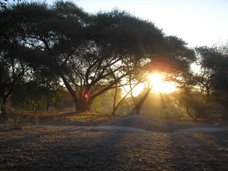
Anne and I saw some good birdlife on the way. We saw our old friend the Roller who is very timid and who only lets you get so close before flying away in a streak of electric blue. We saw a Pied kingfisher fishing and a Hammerkop dabbling. We arrived at the Old Wooden Bridge very late in the afternoon but a beautiful saffron light wast stil shafting through the trees on the Sedia bank. The Old Wooden Bridge always has a very good atmosphere and especially so on a Saturday evening. When I first came up that way I walked past the campsite and met the owner a jolly old Batswana man who told me about his camp and his orchard and how difficult things were for growing crops as Botswana’s rains hadn’t been so good that year.
Anne and I crossed the bridge and decided against followingthe river towards Old Road Bridge and Hippo Pool as it was getting late. If we didn’t want to walk back in the dark we should turn back now. We walked along the spur of land which forms the right arm of the U and into the real forest that covers it. Works of art was part of the that days themes of conversation. One of our conversations touched on Skrimshaw. We’d been approached by an artist outside the Okavango pharmacy the other day selling carved and skrimshawed keyrings which looked suspiciously like ivory. Thankfully Anne has a lot of experience of bones through her work as an archaeologist andwas able to assure us that it was bone.
Now, I’ve been really interested in Skrimshaw ever since my dad brought me home a walrus tusk with an original skrimshaw commemoratingthe victory of the US frigate ‘Constitution’ oover the British manned, captured French ship Guerrier. And I’ve always been up for the opportunity for working in that medium. So one of the things we wereon thelookout for were bones. You can often find Cattle bones a and pieces of mangled goat strewn along the river bank. We found a nice small fragment of femur and as we walked around the promontary found a great cows tibia, nice andfresh. Unfortunately we had to leave it as it was very bigand we had nothing to carry it home in so I will make do with practisingon this nice smooth, shiny piece of femur.
So, like I said, walking back along the Disaneng bank means having to negotiate a loop behind the compounds which run up to the waters edge and a couple of meandering paths through thorny bushes. It is not the quick way home. It does however have the advantage of being the riverbank on which we live so we don’t have to worry about whether we’ll be in time to catch the last makorro across the river.
We picked up the pace as the light began to fade. This is the time of day the riverbank becomes more dangerous as it becomes the haunt of hippos who tend to charge firstand ask questions later. I was feeling confident that we would see any hippo’s before they saw us and also I knew the way home so I was feeling fairly chirpy by comparison to Anne. Now, Anne is no wet behind the ears hobby homoeopath, oh no. I told you before she was an archaeologist and as such she earned her stripes roughing it with the roughest of them in Cyprus, Israel and merrie England. And grew up in Dublin and Birmingham, and Nannied with the best of them in Islington. Anne’s no softie but the prospect of meeting a hippo by surprise was a prospect of no joyous portent.
So as we trecked on and the conversation turned to how we could make the best out5 of an encounter with hippos. I reminded Anne that hippo’s have a big turning circle and so all we would need to do is double back, then again as it was so dark, nipping behind a bush would be a good option as well as doubling back. I was also pretty sure that the hippo’s would spot me better as I was wearing lighter clothes so I could run while Anne nipped behind a bush and then I could double back.
I don’t think these suggestions did much for ither of our confidences but it passed the time. That is until the bats came out. Anne is no fan of bats. But soon and sure enough we reached the path to our back gate and breathed a sigh of relief to be home, safe from marauding hippos and swooping bats. I cooked a light and celebratory cheese omlettes for us both. I had been planning to manage to make the omlette I made for myself as good as the one I made for Anne. Until that evening, if I had ever cooked omlettes for us all I had succeded in slightly overdoing the outside of mine.
Things were going well the eggs beaten with a spoonful of yoghurt were coalescing and turning a pleasing shade of yellow. I swirled the pan and sent the surplus out to the edges thus evening up the depth of the omlette. As I made the salad I paid attention to the pan, now on a low heat until the edges of the omlet began to twitch free of the pan. I picked up the pan and gave it a shake and the omlette slid smoothly. I had decided that I would seal the inside briefly sendit back over and then add the feta cheese.
I flipped the omlette like those wafer perfect pancakes which added extra relish to Chris Coombes and Claire’s party in the Barbican. Down it came, pan perfect and sizzled with the air of a cat which has found a warm and welcoming lap. I jiggled the omlette again. The inside was sealed just nicely, up and over and add the feta. But it was not to be. Oh no. I wasn’t going to be the man who would be eating an omlette just as good as his pal’s that night. Up went the omlette, down campe the omlette only to catch its edge on the pan and come a very nasty cropper.
Polly helped me tidy the kitchen by eating 1/5 of my omlette off the kitchen floor and Anne made me feel a lot better by giving me a little piece of her omlette which was a beauty if I do say so myself. Altogtether, that day a splendid time was had by all.
Wildlife Park
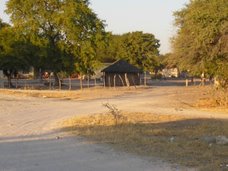
As if we hadn’t had enough. Today (08/07/07) Anne and I drove over to the wildlife park.. This is a fenced off area of bush. You can see the fences from town extending half way into the river and you can walk up to them from our place which gives you an Idea of how big it is.
I think today our mission was really to scout the place out and generally see what we could see. We walked in a straight line pretty much for 2 hours through sage brush and forest and down to the rivers edge. We had some good encounters along the way. First things we saw were squirrels. Then – Wow, excuse this interuption readers but I have just heard a hippo grunt close by. I have heard them in the afternoon on days when I have seen them on the bank but never so late at night and never, apparently so close to the compound. A hippo grunt sounds like a pig grunt about fivetimes in quick succession, grunt-grunt-grunt-grunt-grunt. But of course you can tell that it comes from a larger and more cavernous beastie.
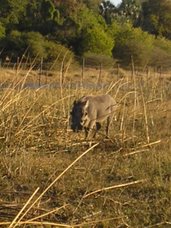
So, next in the wildlifw park we saw pretty warthogs rooting and down at the rivers edge very timid ground hornbills and a fisheagle carrying lunch home in its talons. Also a bearded woodpecker diligently knock-knock-knocking for grubs and really ignoring us until I thought I’d try to take his photo when he became suddenly alert and went to find a more peaceful tree.
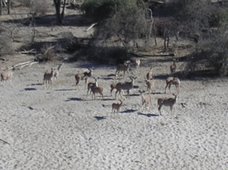
Then, through the trees an ubiquitous sage brush we saw a new russet brown, more vital than the grey looking tree trunks. It was an Impala. Chosing separate paths and moving as slowly and quietly as we could we moved towards them. They had seen us a long time before we had seen them and they transformed themselves into a blur of brown and white and were away. We followed in the direction they had taken, slowly and quietly hoping to glimpse them as they paused.
They are very beautiful creatrues to watch moving, they appear not to touch the ground as they leap away into the shadows. One moment there are three Impala in a clearing standing still and you can feel 6 black eyes watching the way you move. Suddenly the leader will give a snort like a starting gun and many more bodies than you had seen will flach through the dappled shade each one different in size and shape but all part of a stream of energetic beauty.
The wildebeest are much harder to see as they are as grey as the shade and the tree trunks but we made one or two out as the Impala flew noislessly past them, the impala’s golden bodies throwing the grey of the Wildebeest into silhouette.
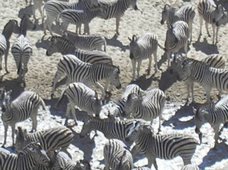
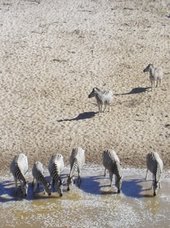
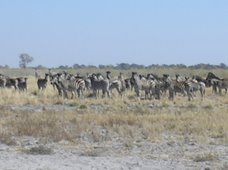
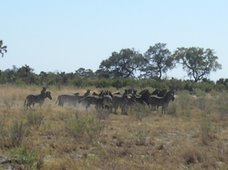
Finally we saw Zebra in groups of three. The Zebra were far less timid than the Impala and far slower moving. One of the group would stand their ground as we approached, face on to us and twitching it’s top lip over it’s teeth. They’re great little horses, if indeed they are horses. Are Zebras horses? A crate of Maun’s finest Champagne to anyone who can tell me! Whatever speicies Zebras belong to they are very good to look at. They are well rounded in a baroque way and move with an indescribable (for me anyway) dignity. I’m so glad I have had the chance to see these animalsup close and in their natural habitat.
We didn’t see the Giraffes which I think are the prize. It would be an amazing experience to be able to walk as close as one could to these animals. I was thinking about the Giraffe recently. They are built along the lines of prehistoric animals yet they really are beautiful and that, I think is what stops them looking so obviously strange. Their beauty takes your mind off their weird shape.
Also, a box of Maun cigars to anyone who can tell me whether there is an Aesop’s fable or Just So Story to explain why chocolate is poisonous to dogs.
Monday, July 09, 2007


Monday, July 02, 2007
Trouble With Triad
The Triad Method is a little bit of a problem for me from the point of view of homoeopathic philosophy and here’s why. I’m classically trained so the basic prescribing method I am familiar with is one appropriate remedy, watch and wait. Whether prescribing for an acute or chronic case. Then repeat or change the remedy according to the response.
In the 6 months before I left for Botswana I’d been familiarising myself with Eizayager’s layers method and so when I was introduced to the Triad Method at my induction for the project it sounded like a reasonable way of going about things. In theory, that is.
In practice it is a lot different. You’ll see in the last post I added (below this one) I’ve given myself a few criteria to use to help me prescribe using the Triad Method, and I’ll use the method because I agreed to do so. Thus, it is possible to rationalise to oneself how to use the triad method. The most difficult thing I am finding in practice at the moment is working out which part of the prescription has worked.
My understanding of the practice of homoeopathy is that you don’t prescribe for separate parts of the case and this is what it feels like is being done here at the project. Having said that, I would feel more at ease with this prescribing method if we were prescribing only two remedies, one for the appropriate totality of symptoms and one nosode. The third remedy seems to me to be superfluous and I feel I’m prescribing it simply to cover bases. This is a scary thing to admit as people are coming to us for help and will surely expect us to know what we are doing.
The other source of confusion about this method is having a remedy for the ‘acute layer’. So far noone I have seen has presented with acute symptoms, either an acute exacerbation of a chronic condition or an opportunistic infection, acute miasm, etc. etc. so merely the name of this layer causes me confusion too.
As I’m sure you can see, I’m pretty confused about this but trying to deal with the confusion by using reflective practice and supervision. It helps me to think things through by writing them down and hopefully by the time I’m further through my stay here I’ll have resolved my questions about the method. I also hope that what I write is being read by other homoeopaths and I’m able to share my experience with them.
The major headache for me at present, after having taken the case and found a third remedy which I feel I can justify within the case is which part of the previous prescription has worked. Patrly this is due to summary sheets only having recently been introduced. 99% of cases have to be read through before the consultations and the key points of the case drawn together while doing this. This is quite a task as the notes are handwritten by several successive homoeopaths. You’ll see throughout the histories that some prescriptions work very well and the next prescription is changed for no apparent reason. Why? I think part of this is due to different practitioners from different backgrounds seeing different things in a case and responding the best way they can see. Another reasonn seems to be practitioners departing from the protocols that have been set by the project. Yet, I still ask myself, why wasn’t the last prescription which brought about a positive change for the patient repeated?
I’ll keep you all posted about how my understanding of the method and it’s application develops. I’m sure all the homoeopaths have been dying for me to actually get on to the subject of actually prescribing etc. The Triad Method is a little bit of a problem for me from the point of view of homoeopathic philosophy and here’s why. I’m classically trained so the basic prescribing method I am familiar with is one appropriate remedy, watch and wait. Whether prescribing for an acute or chronic case. Then repeat or change the remedy according to the response.
In the 6 months before I left for Botswana I’d been familiarising myself with Eizayager’s layers method and so when I was introduced to the Triad Method at my induction for the project it sounded like a reasonable way of going about things. In theory, that is.
In practice it is a lot different. You’ll see in the last post I added (below this one) I’ve given myself a few criteria to use to help me prescribe using the Triad Method, and I’ll use the method because I agreed to do so. Thus, it is possible to rationalise to oneself how to use the triad method. The most difficult thing I am finding in practice at the moment is working out which part of the prescription has worked.
My understanding of the practice of homoeopathy is that you don’t prescribe for separate parts of the case and this is what it feels like is being done here at the project. Having said that, I would feel more at ease with this prescribing method if we were prescribing only two remedies, one for the appropriate totality of symptoms and one nosode. The third remedy seems to me to be superfluous and I feel I’m prescribing it simply to cover bases. This is a scary thing to admit as people are coming to us for help and will surely expect us to know what we are doing.
The other source of confusion about this method is having a remedy for the ‘acute layer’. So far noone I have seen has presented with acute symptoms, either an acute exacerbation of a chronic condition or an opportunistic infection, acute miasm, etc. etc. so merely the name of this layer causes me confusion too.
As I’m sure you can see, I’m pretty confused about this but trying to deal with the confusion by using reflective practice and supervision. It helps me to think things through by writing them down and hopefully by the time I’m further through my stay here I’ll have resolved my questions about the method. I also hope that what I write is being read by other homoeopaths and I’m able to share my experience with them.
The major headache for me at present, after having taken the case and found a third remedy which I feel I can justify within the case is which part of the previous prescription has worked. Patrly this is due to summary sheets only having recently been introduced. 99% of cases have to be read through before the consultations and the key points of the case drawn together while doing this. This is quite a task as the notes are handwritten by several successive homoeopaths. You’ll see throughout the histories that some prescriptions work very well and the next prescription is changed for no apparent reason. Why? I think part of this is due to different practitioners from different backgrounds seeing different things in a case and responding the best way they can see. Another reasonn seems to be practitioners departing from the protocols that have been set by the project. Yet, I still ask myself, why wasn’t the last prescription which brought about a positive change for the patient repeated?
I’ll keep you all posted about how my understanding of the method and it’s application develops. I’m sure all the homoeopaths have been dying for me to actually get on to the subject of actually prescribing etc.
In the 6 months before I left for Botswana I’d been familiarising myself with Eizayager’s layers method and so when I was introduced to the Triad Method at my induction for the project it sounded like a reasonable way of going about things. In theory, that is.
In practice it is a lot different. You’ll see in the last post I added (below this one) I’ve given myself a few criteria to use to help me prescribe using the Triad Method, and I’ll use the method because I agreed to do so. Thus, it is possible to rationalise to oneself how to use the triad method. The most difficult thing I am finding in practice at the moment is working out which part of the prescription has worked.
My understanding of the practice of homoeopathy is that you don’t prescribe for separate parts of the case and this is what it feels like is being done here at the project. Having said that, I would feel more at ease with this prescribing method if we were prescribing only two remedies, one for the appropriate totality of symptoms and one nosode. The third remedy seems to me to be superfluous and I feel I’m prescribing it simply to cover bases. This is a scary thing to admit as people are coming to us for help and will surely expect us to know what we are doing.
The other source of confusion about this method is having a remedy for the ‘acute layer’. So far noone I have seen has presented with acute symptoms, either an acute exacerbation of a chronic condition or an opportunistic infection, acute miasm, etc. etc. so merely the name of this layer causes me confusion too.
As I’m sure you can see, I’m pretty confused about this but trying to deal with the confusion by using reflective practice and supervision. It helps me to think things through by writing them down and hopefully by the time I’m further through my stay here I’ll have resolved my questions about the method. I also hope that what I write is being read by other homoeopaths and I’m able to share my experience with them.
The major headache for me at present, after having taken the case and found a third remedy which I feel I can justify within the case is which part of the previous prescription has worked. Patrly this is due to summary sheets only having recently been introduced. 99% of cases have to be read through before the consultations and the key points of the case drawn together while doing this. This is quite a task as the notes are handwritten by several successive homoeopaths. You’ll see throughout the histories that some prescriptions work very well and the next prescription is changed for no apparent reason. Why? I think part of this is due to different practitioners from different backgrounds seeing different things in a case and responding the best way they can see. Another reasonn seems to be practitioners departing from the protocols that have been set by the project. Yet, I still ask myself, why wasn’t the last prescription which brought about a positive change for the patient repeated?
I’ll keep you all posted about how my understanding of the method and it’s application develops. I’m sure all the homoeopaths have been dying for me to actually get on to the subject of actually prescribing etc. The Triad Method is a little bit of a problem for me from the point of view of homoeopathic philosophy and here’s why. I’m classically trained so the basic prescribing method I am familiar with is one appropriate remedy, watch and wait. Whether prescribing for an acute or chronic case. Then repeat or change the remedy according to the response.
In the 6 months before I left for Botswana I’d been familiarising myself with Eizayager’s layers method and so when I was introduced to the Triad Method at my induction for the project it sounded like a reasonable way of going about things. In theory, that is.
In practice it is a lot different. You’ll see in the last post I added (below this one) I’ve given myself a few criteria to use to help me prescribe using the Triad Method, and I’ll use the method because I agreed to do so. Thus, it is possible to rationalise to oneself how to use the triad method. The most difficult thing I am finding in practice at the moment is working out which part of the prescription has worked.
My understanding of the practice of homoeopathy is that you don’t prescribe for separate parts of the case and this is what it feels like is being done here at the project. Having said that, I would feel more at ease with this prescribing method if we were prescribing only two remedies, one for the appropriate totality of symptoms and one nosode. The third remedy seems to me to be superfluous and I feel I’m prescribing it simply to cover bases. This is a scary thing to admit as people are coming to us for help and will surely expect us to know what we are doing.
The other source of confusion about this method is having a remedy for the ‘acute layer’. So far noone I have seen has presented with acute symptoms, either an acute exacerbation of a chronic condition or an opportunistic infection, acute miasm, etc. etc. so merely the name of this layer causes me confusion too.
As I’m sure you can see, I’m pretty confused about this but trying to deal with the confusion by using reflective practice and supervision. It helps me to think things through by writing them down and hopefully by the time I’m further through my stay here I’ll have resolved my questions about the method. I also hope that what I write is being read by other homoeopaths and I’m able to share my experience with them.
The major headache for me at present, after having taken the case and found a third remedy which I feel I can justify within the case is which part of the previous prescription has worked. Patrly this is due to summary sheets only having recently been introduced. 99% of cases have to be read through before the consultations and the key points of the case drawn together while doing this. This is quite a task as the notes are handwritten by several successive homoeopaths. You’ll see throughout the histories that some prescriptions work very well and the next prescription is changed for no apparent reason. Why? I think part of this is due to different practitioners from different backgrounds seeing different things in a case and responding the best way they can see. Another reasonn seems to be practitioners departing from the protocols that have been set by the project. Yet, I still ask myself, why wasn’t the last prescription which brought about a positive change for the patient repeated?
I’ll keep you all posted about how my understanding of the method and it’s application develops. I’m sure all the homoeopaths have been dying for me to actually get on to the subject of actually prescribing etc.
On another tack altogether…It’s ten past nine on a cool June’s night. Julia has, within the last hour recovered from an energy sapping cold type thing, thanks to homoeopathy and Hilary-Coffee-Shop’s thoughtfully sending Julia some Butternut Squash Soup and Carrot Cake. Julia is blasting out tunes on the Lutheran Church’s guitar which she borrowed to restring. We’ve had I’ve Been A Miner For A Heart Of Gold, Lady Darbanvilles, the song which begins Ziggy Played Guitar, and several others that went in one ear and out the other while I was typing.
So, when the working day is done we get a good opportunity to relax and re-energise like good, hard thinking, hard working, reflective homoeopaths should.
So, when the working day is done we get a good opportunity to relax and re-energise like good, hard thinking, hard working, reflective homoeopaths should.
Tuesday, June 26, 2007
Hippo Epilogue
There is an epilogue to the tale of the Hippo's standing beside the path on Monday evening. This morning I decided to walk into town (26/06/07). Who do you think I should meet in exactly the same spot but the hippo's again. Today it didn't cross my mind to retrace my steps to the small makorro and cross to the Sedia bank, walk up to Big Tree and get a combie into town. I just decided it was time to explore a bush path arouind the hippos.
Sorry folks, I've just realised that I have been putting an apostrophe on hippo when writing about hippopotami. That must have been so annoying for you. Shaln't do it again.
So, I slowly veered left onto the soft sand and into the thorny protection of the bush. Taking one very carful twig avoiding pace at a time I proceeded towards but awat from the hippos. As I drew level with them voices on the opposite bank began to bid me HELLO & GOOD MORNING at the tops of their lungs. It was the soldiers from the Barracks on the opposite bank at the end of their pier shouting encouragement (wether to me or the hippos I'm not sure, I reckon watching someone getting chased through the thorny bush by a playful and curious hippo would be a nice diversion fro barrack-room monotony).
The fact that I am writing from Riley's and not Maun General Hospital wildlife maimings ward this is eveidence that the hippos had had a heavy breakfast and were in no mood for play as I gently made my way past them.
Work Experience
Where am I now?
I'm still in Maun, of course. I'm just beginning my third week here and I've just begun taking cases on my own. Last week I was alternating with Julia. Having her there to discuss case analysis and remedies with me made things a lot easier, it felt a lot less pressurised than thinking alone.
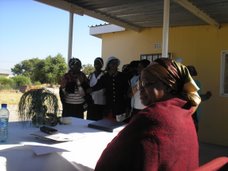
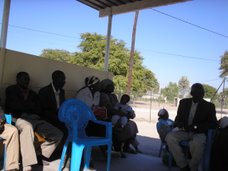
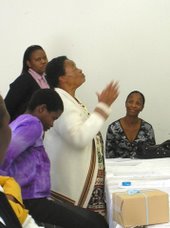
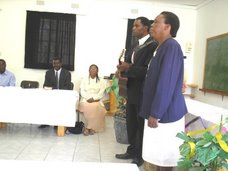
Since I arrived we've been working at a reasonable pace and our days have been varied for one reason or another. As you'll see from the photo's, last Monday we were invited to Boseja Kgotla to explain what the project is about. Usually we are at the Lutheran Church Clinic on a Monday from 0800 - 1600 with an hour for lunch. That afternoon we could go home early as noone had come to clinic that afternoon.
Tuesday's we're at WoMen Against in the morning and seeing private patients in the afternoon. That's a very different kettle of fish altogether as we do not have to use the Maun Homoeopathy project triad method. You'll have read about that in the post above this. I'm going to try and fix it so that My postings run chronologically from oldest at the top to most recent at the bottom. It doesn't make sense, the way it is now.
Wenesdays we do home Visits for Lutheran Church Clinic Patients and Thursday's were back at the Lutheran Church Clinic all day. Friday is always varied as we go on a thrice weekly rotation to Boseja Kgotla Clinic, Maun Conselling Clinic or Sennonori, which is run by the woman who comes each week to sweep our yard and do our washing. A good example of the blurred boundaries we are always warned about!
Tell Us About The Triad
OK. The triad ought to be fairly easy for most homoeopaths to understand as it seems to be based on Eizayagers 'Layers Method'. However, rather than treating each layer of the case sepparately we prescribe concurrently. At present i'm not quite sure of how the Triad came to be used. I feel a bit of an idiot because of that. Why didn't I bother asking? Hmmm.
I'm still in Maun, of course. I'm just beginning my third week here and I've just begun taking cases on my own. Last week I was alternating with Julia. Having her there to discuss case analysis and remedies with me made things a lot easier, it felt a lot less pressurised than thinking alone.
Since I arrived we've been working at a reasonable pace and our days have been varied for one reason or another. As you'll see from the photo's, last Monday we were invited to Boseja Kgotla to explain what the project is about. Usually we are at the Lutheran Church Clinic on a Monday from 0800 - 1600 with an hour for lunch. That afternoon we could go home early as noone had come to clinic that afternoon.
Tuesday's we're at WoMen Against in the morning and seeing private patients in the afternoon. That's a very different kettle of fish altogether as we do not have to use the Maun Homoeopathy project triad method. You'll have read about that in the post above this. I'm going to try and fix it so that My postings run chronologically from oldest at the top to most recent at the bottom. It doesn't make sense, the way it is now.
Wenesdays we do home Visits for Lutheran Church Clinic Patients and Thursday's were back at the Lutheran Church Clinic all day. Friday is always varied as we go on a thrice weekly rotation to Boseja Kgotla Clinic, Maun Conselling Clinic or Sennonori, which is run by the woman who comes each week to sweep our yard and do our washing. A good example of the blurred boundaries we are always warned about!
Tell Us About The Triad
OK. The triad ought to be fairly easy for most homoeopaths to understand as it seems to be based on Eizayagers 'Layers Method'. However, rather than treating each layer of the case sepparately we prescribe concurrently. At present i'm not quite sure of how the Triad came to be used. I feel a bit of an idiot because of that. Why didn't I bother asking? Hmmm.
So, I'll tell you about what I know about the triad method so far and what my experience is of it, so far. My opinions are bound to change as I have only been here two weeks so far (today is Tuesady 26th of June) and I have not been in touch with Hilary to get an idea of how the method developed. Anyone reading this from top to botom will read my most recent insights first.
The Triad Layers
The Triad Layers are - 1) Acute; 2) Constitutional; 3) Miasmatic.
At present I'm finding this method a little unwieldy, mainly because very few people we see have acute illnesses, their symptoms are long standing. Because of this I could understand prescribing a remedy for the chronic illness and another for the miasm but having to work in a third seems to me to be a bit of a contrivance.
But, we have to prescribe this way as Hilary wants to see the results of long term Triad prescribing. Things probably wouldn't be so rigid but for characters like me turning up and saying 'I'm not prescribing like that!' and doing their own thing. Luckily for the project I am not in a rebellious mood and I am happy to follow the protocol and see where it takes me
So that I feel happpy using the Triad method I've worked out a few ways of justifying to myself why 3 remedies are being prescribed.
My idea of how to Prescribe for "Acute" Layer = 1) remedy for totality of an acute miasm or exacerbation of chronic disease; 2, As a support for acute mental emotional states if Px has chronic symptoms.
Constitutional Layer: Patterns of Health / Ill Health & Menatal Emotional Reactions.
Miasm: Can an appropriate miasmatic link be made between acute and chronic symptoms? Which miasm is most obvious in the case?
And it feels even better prescribing this way if the remedies used can be related. Still, at present I'd feel less of a headache using just one or two remedies at a time.
So that I feel happpy using the Triad method I've worked out a few ways of justifying to myself why 3 remedies are being prescribed.
My idea of how to Prescribe for "Acute" Layer = 1) remedy for totality of an acute miasm or exacerbation of chronic disease; 2, As a support for acute mental emotional states if Px has chronic symptoms.
Constitutional Layer: Patterns of Health / Ill Health & Menatal Emotional Reactions.
Miasm: Can an appropriate miasmatic link be made between acute and chronic symptoms? Which miasm is most obvious in the case?
And it feels even better prescribing this way if the remedies used can be related. Still, at present I'd feel less of a headache using just one or two remedies at a time.
Sunday, June 17, 2007
One Week In Maun
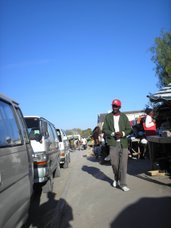
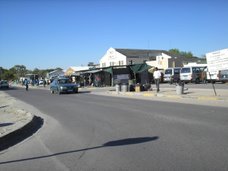
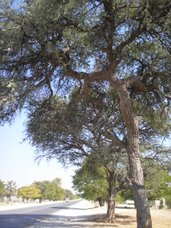
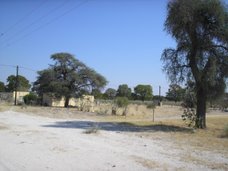
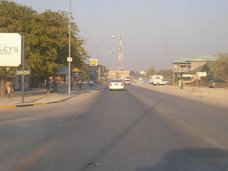
I've been in Maun for exactly one week now. It's Sunday afternoon and I've walkwd into town. It takes about 45 minutes along the main road. It's a nice walk, Sedia road is lined with compounds and big spreading trees, it has a good atmosphere, even at midday.
Mad Dogs And Englishmen
Today is Sunday. We've got the whole day to ourselves. I actually had a lie in until 8.30 this morning but I got out of bed as i didn't want to waste my day off. Last night I walked back into town along Sedia road in the evening light as busineses were beginning to close down and the Sedia road bars began to warm up.
It was 11.45 when I finally left our compound and walked back, out across the dry Thalakwe river bed which runs behind the compound. I was also scouting to see whether our backie (pick up truck) would cope with crossing the river bed and negotiating the sandy banks leading up to Big Tree combi stop on the Sedia road.
What's Sedia Road?
Sedia road is the long straight roadwhich runs west out of Maun, roughly parallel to the river. If we could cross the river on our backie and get onto Sedia road we'd avoid a really dusty circuitous route in the mornings and evenings.
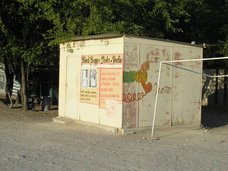
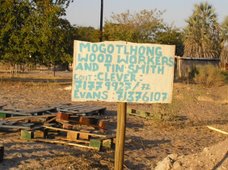
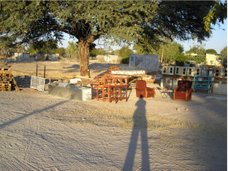
As I said, the road is tree lined in the typically African widely spaced way. On either sides are home compounds often with a little business attached. This seems to be the metal workers quarter as there are about 3 aluminium and tin workers, an equal number of welders & at least 2 mechanics that's in the 45 minute walk between big tree and new mall. There's a couple of bars, at least four so it makes for a varied lanscape. I was hoping I'd be able to upload my phot's of Sedia road today but someone seems to have removed Microsoft publisher from this computer so i can't save my photo's a small file which is easy to upload. There's also the airport. Running parallel to the north of Sedia road is Maun airport.
My Week
Tuesday we went to WAR (WoMen Against Rape). As I'm sure you'll understand I didn't see many of the patients there but I had a chance to see how the place was set up and feel it's atmosphere. It was actually quite familiar. It had the same atmosphere as many of the projects i'd worked with in London when I was with the Tuffnell Park NHS. So, I feel comfortable working there.
Private Clinic
Tuesday afternoon we have a private clinic in the Okavango Pharmacy in the centre of town. This didn't happen because most of our patients for that day were ex-pats and they were tied up with organising the charity event at the Sports Bar, which is also on Sedia Road.
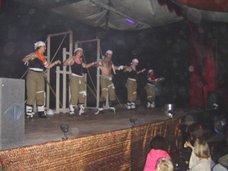
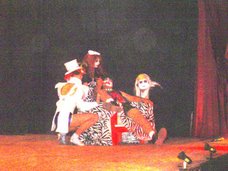
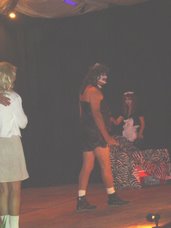
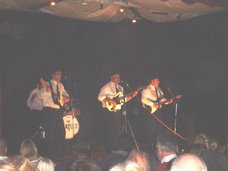
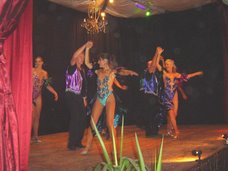
Sports Bar Royal Variety Charity Show
So, Tuesday we got to go home early. This worked out well for Julia an I as we had to get home file things and such, have a bite to eat and get washed and changed for the evenings entertainment. Tickets were 180 Pula each which works out as roughly 18 Pounds! And this went to charity.
As an incentive a 'bottemless pot' of soup was offered and it was very welcome as it was a cool desert night. All of Maun society were there, whether Batswana or Ex-Pat. Marty, our land-lady who we wnt with told us that she'd introduce us only to the people worth knowing . That ammounted to two people and I only remember one of them as he was Hilary's husband.
So there we are sitting under a ceiling of coloured cloth a good 15 or 20 feet above our heads, facing a stage surrounded by swags of red velvet in the true theatrical style. With real working curtains.
One of the most curious things about the performance was the inter act words given by the comperes. The man an urbane character built along the lines of 'The Great Suprendo' but with less hair and his partner a spiky Afrikaans vrau who seemed to have forgotten that she was no longer in front of a class of children, who kept telling the children in the front row to keep quiet. She ended up getting a well earned booo!
So, their inter act commentary, as well as containing the usual jokes at the audiences expense gave a slightly over detailed explaination of what we were about to witness. On reflection this was possibly for thwe benefit of the Batswana members of the audience, a gesture of courtsesy perhaps, except the explaination wasn't given in Setswana. The take home message is, before each act there was about 5 minutes at least of detailed explaination giving the history of the piece and a little about those who first performed it. That struck me as an interesting way to go about things.
They don't know when to stop
Just when it looked as though the last act had been seen there came another. I was sitting there thinking, people who are capabe of this are capable of anything. Everyone really pot their hearts into what they were doing. Even the poor guys who had to entertain us during really long scene changes and had to resort to singing a rude children's rhyme about a farmer in a field sitting on a rock whith his hands in his pocket playing with his keys etc, etc, you know the sort of thing, to get a laugh.
Monday, June 11, 2007
What was your first day at work like?
It began early at 6 o'clock and it felt earlier as it was still dark. Luckily it was probably the warmest morning Maun hashad for a few weeks, otherwise it would have been freezing.
Weha to be up early as Hilary, who set up the projct 5 years ago, was flying home and was giving a talk to the district health workers about the role of the project at 07.30! We drove through the scrubby brush jungle from our cottage on the bank of the river as the sun wa rising.
As it was my first day I was sitting in with Julia who has worked on the project before.About half the patients we saw needed an interpreter. This was a new and interesting experience for me but I didn't feel it detracted from the quality of the consultation. The rapport is built up between the patient and practitioner. The interpreter passes information betwen them. Of course, the interpreters have been trained not to rephrase what patients say or colour the information they relay with their own opinion. Altogether, I think this system works well.
This was only my first day and I'm going totell you more about what it's like to run a consultation through an interpreter but I was favourably impressed. I don't know what anyone else was tinkng but I recall that while I was studying I was getting theimpresion that the consultation room is a very fragile and sacred space and he slightest 'bad vibe' could upset the whole dynamic of the relationship between patient and practitioner.
It is and it isn't. The consultation and consulting rooms, likepatients are individual, fragile and sacred things which must be approached with humility and the right intention. At the same time, like people they are flexible, adaptable and resilient.
The consultation is made up of two components, patient and practitionr, 3 in Maun if you include an interpreter. When these components are comfortable in the space, wherever it's location, whatever it's shape or size the cosultation will work. Do all the components feel happy? Do they agree to be in the space? Do they know what's going to happen? Yes? OK, carry on, it will work. That's the key.
I'll tell you more about my discoveries in my next thrilling installment of 123 Homoeopathy!
Sunday, June 10, 2007
Maun Sounds Like A Fun Place To Be / मौन सौन्ड्स लिके आ फुं प्लेस तो बे
Drums thundered and waists shook as feet stomped the ground in dance at the freedom square in Sedie, Maun, over the weekend। The dust rose up in the air as a means of appeasing the Mbungu Wa Kathimana ancient gods to welcome and cleanse Botswana National Front (BNF) leader Otsweletse Moupo and his party from the misfortunes that are threatening to tear it apart.
And believe it or not, the cultural cleansing rites seem to have worked, as the sky suddenly turned cloudy and the soft breeze cooled the hot weather.
And believe it or not, the cultural cleansing rites seem to have worked, as the sky suddenly turned cloudy and the soft breeze cooled the hot weather.
I found these on Mmengi Online. Mmegi is published by Dikgang Publishing Company (DPC). The newspaper was established in 1984. Mmegi is the only daily independent newspaper in Botswana. The newspaper is read by a cross-section of the population including students, policy makers, intellectuals and the business community. Over the past 10 years Mmegi won the prestigious Institute of Bankers “Newspaper of the year Award” nine times.
Bats terrorise Maun Civil Servants
NOMSA NDLOVU
CORRESPONDENT MAUN:
An invasion by an army of bats has chased civil servants in Komane village, 26km west of Maun, out of their houses to seek accommodation elsewhere. Councillor Morolong Mosimanyane of Komane ward brought the matter to the attention of the Minister of Environment, Wildlife and Tourism Kitso Mokaila last week and said the bats have been terrorising the village since 2004.
He said that the bats use ceilings as their abode and the most affected houses are those of the teachers, nurses, and local police officers. Morolong told Mokaila that wildlife officers should be sent to deal with the bats. He said if wildlife officers had not prevented them, the residents would have long used other means to wipe out the animals.
"When we reported the matter, your officers instructed that we should not kill the creatures because they are a protected species. They said the only thing we should do is to remove them and patch the ceiling, but we tried and failed. Therefore I request you to send your officers to remove them from our area because we are tired of the anguish that they are causing us," he said.
Morolong explained that the animals are inactive by day but at night they come out of their hiding places and trouble residents. Their noises prevent the civil servants and their families from sleeping and cause panic. The occupants of the houses were then forced to move out and seek accommodation elsewhere. The problem affects most villagers with modern houses.
Morolong told Mmegi that besides the noises, the bats defecate and urinate constantly, causing a pungent smell and resistant stains on clothes, walls and the ceiling.
He said that the bats use ceilings as their abode and the most affected houses are those of the teachers, nurses, and local police officers. Morolong told Mokaila that wildlife officers should be sent to deal with the bats. He said if wildlife officers had not prevented them, the residents would have long used other means to wipe out the animals.
"When we reported the matter, your officers instructed that we should not kill the creatures because they are a protected species. They said the only thing we should do is to remove them and patch the ceiling, but we tried and failed. Therefore I request you to send your officers to remove them from our area because we are tired of the anguish that they are causing us," he said.
Morolong explained that the animals are inactive by day but at night they come out of their hiding places and trouble residents. Their noises prevent the civil servants and their families from sleeping and cause panic. The occupants of the houses were then forced to move out and seek accommodation elsewhere. The problem affects most villagers with modern houses.
Morolong told Mmegi that besides the noises, the bats defecate and urinate constantly, causing a pungent smell and resistant stains on clothes, walls and the ceiling.
What's Maun Like? / वहत इस मौन लिके?
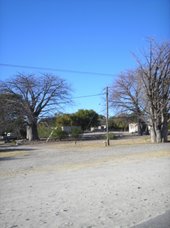
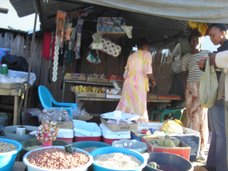
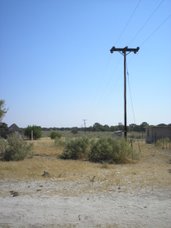
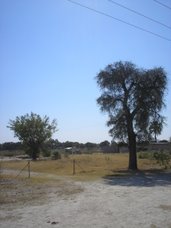
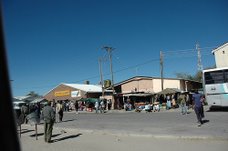
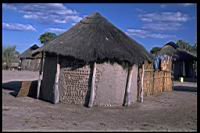
What's Maun like? Widely spaced and dusty. But I can see that there is a lot to explore. I saw my first Boabab trees from the road about 50k outside of town. That made me feel as though I was nearing journeys end. the countryside is broad and flat. There are small settlements dotted around with compounds of thatthced rond-houses and square rond houses also thatthed and more modern style houses. Cows, donkeys and goats occasionally break the monotony of a long straight highway by crossing it, making the bus perform a loooooong slooow down which precipitates a flash flood of shoes bottles and small luggage forward beneath the seats.
I arrived in Maun yesterday evening. We passed the school on theway in. Lads appeared to be playing rugby on a dustbowl of a pitch. There was a big crowd of spectators and the teams wore blue and green. I imagined anyone on that pitch would beabout 2kg heavier when they finnished from all the dust theye'd swallow and breathe in.
I notice sign posts directing me to places that I had heard of from my induction in London. Now I am here I really see how spread out maun is. I'll try and have some images for you next time i write. I'll also be able to tell you about my first day at work.
Stay tuned!
First Day In Maun / फर्स्ट दय इन मौन
I've just arrived in Maun. I spent my first night in Botswana at the splendid Boiketlo Lodge in Gaborone. It's really well placed opposite the Bank and Telecom ofices. There's a driving school 'office' under a tree outside the back gate which faces the Telecom & Bank. The driving school itself consists of an obstacle course of orange cones on a patch ofground beside the road a little further along. A man was entertaining the instructiors singing to a guitar. This was another good introduction to Botswana.
Mr. Moipolai says that Lonely Planet has got it wrong about his guest house. They describe it as 'noisy' apparently. He wasn't happy about that. The edition I read quite rated the place, which is why I chose it. It's certainly not noisy. So any of you with an old edition of Lonely Planet which describes Boiketlo Lodge as noisy, you'd better update it and say that it is clean, well appointed and quiet with a delicate perfume of woodsmoke on the evening air.
Mr Moipolai says that LP perhaps mistook the natural exuberance of Motswana for irritating noise. We are jolly people, we always greet, domella ma! Domella rra! You will see it when you get the bus, we are always greeting.
I was looking forward to a bit of this as things had been pretty quiet I thought. Everyone on the Mainliner kept themselves to themselves and everyone I'd seen in Gabborone deported themselves with the utmost decorum.
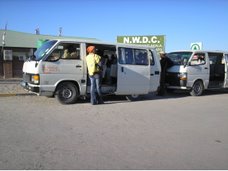
This changed I am happy to say, when I reached the bus station. It was as bright, noisy, ramshackle and full of human life as I had expected.Busses heave in and out, their touts roam the area shouting their destinations. People laden with great tarten laundry bags of luggage surge back and forth, with politeness and decorum. Vendors hawk fruit, mouth watering packets of chicken and chips made by Hungry Lion & Cicken Licken, chicken pies by Pie Perfect, Cold water, frozen into ice, Iron Brew, sweeties in buckets, wallets, passport covers & pocket-books, The Voice, The Botswana Guardian, pencils, plastic doccument wallets, air time for mobile phones.
The bus slowly fills up with passengers and vendors pass on and off like salts through a cell.There's always space to squeeze by and everything passes off with the utmost tact and decorum. There's some banter between passengers and vendors but everyone kepps themselves to themselves and are decorous.
Dr. Scientist
As we pull out of the bus station we pass more vendors stalls and food spots. Then, at one corner I see a crowd of people cathered round a larger shack. Inside is a sound system beside which sits a man with a really curious peice of woodwork in his hands.
It looks as though he is holding an instrument madefrom planks and 2 by four, held together with bolts. He's advertised as Dr. Scientist. There's a pile of compact discs on the sound system and a hand printed T shirt swings above them. He's tuning up to play that gorgeous rippling African guitar music. Notes and phases sparkle out and hit you in the heart. I'm straining my ears backwards as we pass away listening to the stretche d notes through the doppler effect. Resolved: I will track down and buy a copy of Dr. Scientist's CD when i return to Gaborone.
Intercape Mainliner / इंटर-कापे Mainliner
I am not eaten by Werewolves and survive my encounter with the hostile world beyond the bus-station.I observe closely what Jo'burg looks like as we pull out of the bus station on the Intercape Mainliner bound for Gaborone, 6 hours away.
We pass through streets lined with smart, low-rise, 1950's style office buildings and more modern standard concrete buildings. The streets are wide low valleys and have a nice mountainous feel to them, one side of the street in freezing shade, one side in bright sunlight. The place has a sunday feel to it, very few people on the streets. There's a lazy mellow atmosphere. I nod off for about three hours and when I wake up we're out in the country in the magical 2 hours before sunset.
The green, red and yellow landscape becomes more subtly coloured and reflects the delicate sunset colours in the sky. Along the way are scrubby spiny kops which smoulder in misty smokey reds, oranges and purple. I really want to be out there, just for an hour or so, to take a walk into the mysterious scrub and over to one of the kops, that would be a nice introduction to the country. Brew up some tea on a tiny wood fire and enjoy the smell of dusty earth, saps and woodsmoke as night falls. Resolved: I will do this as soon as I can when I reach Maun.
Subscribe to:
Posts (Atom)