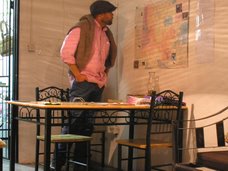
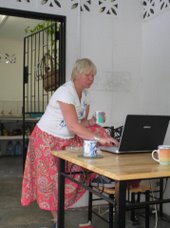
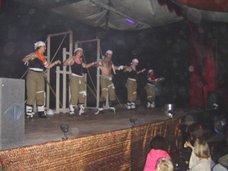
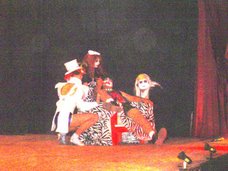
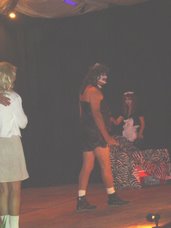
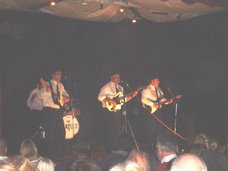
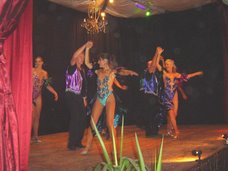
We had another foray into Maun soiety last night at a super-pub-quiz at Matshwane school. We went there with Hilary, she actually paid for half of our entrance as there was a deficit of two people on her table. We were seated with Anna-Lise who runs the gym and played Little Nell in the charity show production of Rocky Horror Show. There were four other people plus Hilary, Me, Anna, Helen & Lutz. Helen was an ex-park ranger from Southwark and Lutz was a really chucklesome pilot.
The table next to us were beefy Afrikaans pirates, some people came in fancy dress. They made a reall noise but were very funny and good fun. There was easily a hundred people in the great hall and like all Maun social events became a little too much of a good thing towards the end. But let me tell you what the good things were. Fun was the biggest good thi ng. There were hoots and cat-calls and local in jokes while the questions were being asked. The Dominatrix from the Maun charity concert was in charge of questions and crowd control. She’d done her best to make herself look like Ane Robinson of Weakest Link fame but in attitude she made Anne look like a drowned pussy-cat.
Then there was the food, provided by the schools Indian contingent. They had prepared a succulent chicken curry with REAL ROTI that was one of the highlights for me. Then there was meeting people. Anna-Lise is good fun but she was way down the other end of the table. I also met a woman who had surprised me that lunch time by saying hello to me in Hilary’s. She was one of those people who look dreadfully familiar but one can’t place. Anyway, she was very nice and very pleased to know that there were homoeopaths in Maun. Lutz was a funny guy and most of what we said to one another resulted in laughter on both sides. Karaoke was also a good thing. Instead of questions, one segment was singing. We all had to sing as a team. It’s Not Unusual by the inimitable Tom Jones was our song and I am pleased to say that Anne and I gave a good account of ourselves on backing vocals. But consider, 8 tables taking about 5 minutes each to get to the front and get their song set up and then sing about 2 minutes of it. Christ, it went on for almost an hour! The good thing was, the tunes were all danceable so that’s what was done.
By the time the winners had been announced, raffles drawn, other prizes handed our etc. It was one o’clock AM. And still there had to be the disco! Most people left including us as Hilary had taken us there and was heading home. The usual hard core of troublemakers stayed and with a regretful backward glance we left.
Showing posts with label Maun. Show all posts
Showing posts with label Maun. Show all posts
Friday, August 17, 2007


Sunday, August 05, 2007
Rowland's African Day
I had a really African day on Saturday. For the first time in a long while I’vefelt as though I’m actually in Africa. In recent days we’ve been becoming busier and busier in and out of clinics and except for a visit to Hilary’s house we’ve just been working, doing admin to keep things running and going home.

However, things changed for me on Saturday when I had a bit of an odyssey. Saturday was the day Noah was meant to visit and check our poor weak backie out and see what was wrong with it and put it right. Anne elected to stay behind and wait for him as she was sick and tired of driving our sick and tired backie around. So I went in to town.
My first stop was at the barbers. I had intended tosee the guy again who Alex had reccomended at airport junction but he was not around so I walked up to Old Mall as there is a profusion of barbers shelters there.
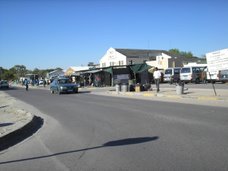
The day was bright and the air was cool as I walked into town as it was not yet ten o’clock. It’s a nice feeling to walk along roads which you normally drive down in the heat of midday, full of traffic between one appointment or another and these roads are quiet and the traffic moves slowly.
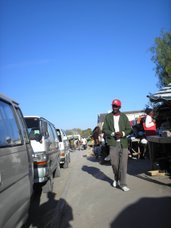
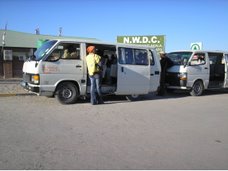
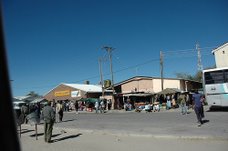
As usual there were crowds of people and vehicles outside shoprite, combies still jostled for position at the rank and the soundsystem still played fluid rythmic tunes into the air but I had time to take it in. The bright light forces you to squint and this narrows your field of vision to a space immediately in front of you and the environment is felt rather than seen until you reach a patch of shade and can widen your vision and take things in.
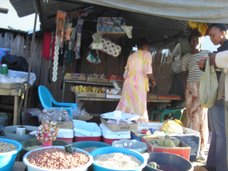
You can see big built Batswana middle class families coming and going at shoprite in big 4X4’s, tiny barefoot children with tinier siblings stand in groups intent on childish things, there are young women getting their hair braided in the shade of trees and awnings, phone credit hawkers in yellow vests break away from the crowds at the bus station like free electrons from the nucleus of an atom, flash youths in baseball caps, polo shirts and ripped jeans prowl the mall, young guys stand in groups chatting, laughing, smoking shouting out to their friends passing in cars, great stately Hereo women in brightly colored cloth sailing through the dust and crowds, gents in dark two-piece suits, collar and tie wearing stinge brim trilby’s looking like CIA men.
Like the Indian barber who practices his art on the street in the shade of a tree the barbers of Maun work in shacks made from planks and shade netting which provide a cool cave like shelter from the bustle of the street. Inside written in felt tip on the wall is the tarrif and below it are glued fragments of a mirror in which you can see your portrait as Picasso might have painted it.
You can choose an office cut, an English cut, a brush cut, a brush cut punk, or just a shave-no-style. Not knowing what to choose I asked the barber to make my hair short and smart and waited for the sesult.
Anne and I are hoping to include some barbers signs in the Sign Safari. They all appear to be in the same hand and include 3 heads which look like they are Batswana celebrities copied from films or newspapers. And, they all appear to advertise 3 styles, short, very short and shiny. I was fortunate and came away with a sort of Matt Gloss, which suited me fine.
I then turned my footsteps down Tsheko Tsheko road, past Choppies another big supermarket on one side and the victorian looking general dealers, butchers shop and electrical dealers on the other, with it’s concrete arcade and cool, dim, cavernous shops entered by a single door and smelling of dust and dried goods. Down Tsheko Tsheko road (which means Court-Case Court-Case Road) to the 4 way junction and turned left at the Hereo settlement corner and headed down to the small bridge which would take me to the Francistown road.
On my way there I passed students in their blue uniforms, I was passed by a wedding party driving slowly and tooting, a group of singers in lime green shirtsand orange waistcoats belting out songs from the back of a backie and giving thumbs up to everyone they pass, donkeys drowsing by the side of the road, herds of apparently unacompanied goats coming upo the embankment beside the bridge, horses wading in the river nibbling reeds, young people looking as though they are waiting to meet other young people on the bridge and finally I turn right, onto the Francistown road.
The Francistown oad is long and straight and in the full heat of the day, I pass builders yards and garages and the take-away/liquor rests that we pass on our way back from the pool which look so lively and inviting in the light of a Saturday evening. Cars pull up and drive away, a few people hang around outside drinking soft drinks and talking into mobiles, huddles of people with there baggage stand in the dust in the shade waiting for the hourly Francistown combie.
I reach the Ubuntu Cellphone & Landline shop and remember that I’ve not year eaten breakfast. But first, a note on Ubuntu. What is Ubuntu, Mageu maize milk ‘Salutes the Spirit of Ubuntu’, a liqueur made from Morula trees is decorated with ‘Ubuntu Beads’. Mary tells me that Ubuntu, roughly translated means ‘ancestral spirit or the soirit of the ancestors or something very traditional.
I head for the second Take-Away/Liquor-Rest outside of Maun, the Boseja Take-Away. These places, like the general dealer and butchers I mentioned earlier have a victorian appearance, being a single storey L shaped block of a building with the roof coming down low over the walk in front of the stores and making an arcade. These are the parts of Maun that really give it it’s frontiers-town atmosphere. Again the stores inside are dim and quaint knocked together looking. The Boseja Take-Away consisted of a counter behind which stood three big coke and beer fridges, full of beer, coke, softdrinks and things to be kept cool. On the counter in a glass prism were bags of fresh doughnuts and sliced grubby looking bread (aside from Hilary’s home-made bread available in loaves from the coffee shop bread is in a pretty low stageof evolutin here) and plates of Chicken & Macaroni, Chicken & Rice, Chicken & Papa.
There was a hand drawn and decorated ‘halal’ sign over the kitchen door and the place was run by a smiling, friendly Indian man with big Indian hair and a moustache. He was very helpful in explaining the intricacies of his menu and so I chose the chicken and macaroni which was spiced up by a big blob of ketchup. As I dined I was able to appreciate the idiosyncracies of decoration within the Take-Away. The walls were a smoky orange and were overpainted with abstract unmistakeable tiger stripe patterns. What lent the place a disturbing quality was the addition of about 4 pairs of Tigers’ eyes peering through the jungle and looking hungrily at the customers as they ate their chicken.
MMMM! That filled a yawning chasm at my core and I set off bouyed by a healthy balance of spices, e-numbers, protein and carbohydrate for my weekend swim.
I had still further to walk before the giant watertower on stilts which marks Matshwane school appeared. I let myself in as there was no old deuteronomy guarding the gate and went to the pool. Walking round to the deep end the air felt warmer than usual. I steeled myself to dive into the icy night cooled waters and dived in. Yet, I was pleasantly surprised to find that the water wasn’t quite so cold and when I reached the other end of the pool I was even happier to find that I was withouth the urge to leap out of the pool, dry off and bake for the rest of the day. I lounged for a bit with my elbows on the side and enjoyed the contrast of the hot sun, warm breeze and now invitingly cold water.
I did 18 lengths in two sessions with a baking out period in between. I was once again pleasantly surprised at my stamina which I now, on reflection ascribe to the running I now do every other day. As I knew I had a long walk back into town and dinner at Marty’s at 6 I left at about 3.30 while the sun was still hot.
The problem now was how to get home with the greatest expedience without having to walk home the way we drive as it is a very very dusty road. The easiest way would be a combie to the big bridge and then walk down along the river. This is what happened and so I was able to enjoy a walk home along the river in the beautiful African afternoon light.

However, things changed for me on Saturday when I had a bit of an odyssey. Saturday was the day Noah was meant to visit and check our poor weak backie out and see what was wrong with it and put it right. Anne elected to stay behind and wait for him as she was sick and tired of driving our sick and tired backie around. So I went in to town.
My first stop was at the barbers. I had intended tosee the guy again who Alex had reccomended at airport junction but he was not around so I walked up to Old Mall as there is a profusion of barbers shelters there.
The day was bright and the air was cool as I walked into town as it was not yet ten o’clock. It’s a nice feeling to walk along roads which you normally drive down in the heat of midday, full of traffic between one appointment or another and these roads are quiet and the traffic moves slowly.
As usual there were crowds of people and vehicles outside shoprite, combies still jostled for position at the rank and the soundsystem still played fluid rythmic tunes into the air but I had time to take it in. The bright light forces you to squint and this narrows your field of vision to a space immediately in front of you and the environment is felt rather than seen until you reach a patch of shade and can widen your vision and take things in.
You can see big built Batswana middle class families coming and going at shoprite in big 4X4’s, tiny barefoot children with tinier siblings stand in groups intent on childish things, there are young women getting their hair braided in the shade of trees and awnings, phone credit hawkers in yellow vests break away from the crowds at the bus station like free electrons from the nucleus of an atom, flash youths in baseball caps, polo shirts and ripped jeans prowl the mall, young guys stand in groups chatting, laughing, smoking shouting out to their friends passing in cars, great stately Hereo women in brightly colored cloth sailing through the dust and crowds, gents in dark two-piece suits, collar and tie wearing stinge brim trilby’s looking like CIA men.
Like the Indian barber who practices his art on the street in the shade of a tree the barbers of Maun work in shacks made from planks and shade netting which provide a cool cave like shelter from the bustle of the street. Inside written in felt tip on the wall is the tarrif and below it are glued fragments of a mirror in which you can see your portrait as Picasso might have painted it.
You can choose an office cut, an English cut, a brush cut, a brush cut punk, or just a shave-no-style. Not knowing what to choose I asked the barber to make my hair short and smart and waited for the sesult.
Anne and I are hoping to include some barbers signs in the Sign Safari. They all appear to be in the same hand and include 3 heads which look like they are Batswana celebrities copied from films or newspapers. And, they all appear to advertise 3 styles, short, very short and shiny. I was fortunate and came away with a sort of Matt Gloss, which suited me fine.
I then turned my footsteps down Tsheko Tsheko road, past Choppies another big supermarket on one side and the victorian looking general dealers, butchers shop and electrical dealers on the other, with it’s concrete arcade and cool, dim, cavernous shops entered by a single door and smelling of dust and dried goods. Down Tsheko Tsheko road (which means Court-Case Court-Case Road) to the 4 way junction and turned left at the Hereo settlement corner and headed down to the small bridge which would take me to the Francistown road.
On my way there I passed students in their blue uniforms, I was passed by a wedding party driving slowly and tooting, a group of singers in lime green shirtsand orange waistcoats belting out songs from the back of a backie and giving thumbs up to everyone they pass, donkeys drowsing by the side of the road, herds of apparently unacompanied goats coming upo the embankment beside the bridge, horses wading in the river nibbling reeds, young people looking as though they are waiting to meet other young people on the bridge and finally I turn right, onto the Francistown road.
The Francistown oad is long and straight and in the full heat of the day, I pass builders yards and garages and the take-away/liquor rests that we pass on our way back from the pool which look so lively and inviting in the light of a Saturday evening. Cars pull up and drive away, a few people hang around outside drinking soft drinks and talking into mobiles, huddles of people with there baggage stand in the dust in the shade waiting for the hourly Francistown combie.
I reach the Ubuntu Cellphone & Landline shop and remember that I’ve not year eaten breakfast. But first, a note on Ubuntu. What is Ubuntu, Mageu maize milk ‘Salutes the Spirit of Ubuntu’, a liqueur made from Morula trees is decorated with ‘Ubuntu Beads’. Mary tells me that Ubuntu, roughly translated means ‘ancestral spirit or the soirit of the ancestors or something very traditional.
I head for the second Take-Away/Liquor-Rest outside of Maun, the Boseja Take-Away. These places, like the general dealer and butchers I mentioned earlier have a victorian appearance, being a single storey L shaped block of a building with the roof coming down low over the walk in front of the stores and making an arcade. These are the parts of Maun that really give it it’s frontiers-town atmosphere. Again the stores inside are dim and quaint knocked together looking. The Boseja Take-Away consisted of a counter behind which stood three big coke and beer fridges, full of beer, coke, softdrinks and things to be kept cool. On the counter in a glass prism were bags of fresh doughnuts and sliced grubby looking bread (aside from Hilary’s home-made bread available in loaves from the coffee shop bread is in a pretty low stageof evolutin here) and plates of Chicken & Macaroni, Chicken & Rice, Chicken & Papa.
There was a hand drawn and decorated ‘halal’ sign over the kitchen door and the place was run by a smiling, friendly Indian man with big Indian hair and a moustache. He was very helpful in explaining the intricacies of his menu and so I chose the chicken and macaroni which was spiced up by a big blob of ketchup. As I dined I was able to appreciate the idiosyncracies of decoration within the Take-Away. The walls were a smoky orange and were overpainted with abstract unmistakeable tiger stripe patterns. What lent the place a disturbing quality was the addition of about 4 pairs of Tigers’ eyes peering through the jungle and looking hungrily at the customers as they ate their chicken.
MMMM! That filled a yawning chasm at my core and I set off bouyed by a healthy balance of spices, e-numbers, protein and carbohydrate for my weekend swim.
I had still further to walk before the giant watertower on stilts which marks Matshwane school appeared. I let myself in as there was no old deuteronomy guarding the gate and went to the pool. Walking round to the deep end the air felt warmer than usual. I steeled myself to dive into the icy night cooled waters and dived in. Yet, I was pleasantly surprised to find that the water wasn’t quite so cold and when I reached the other end of the pool I was even happier to find that I was withouth the urge to leap out of the pool, dry off and bake for the rest of the day. I lounged for a bit with my elbows on the side and enjoyed the contrast of the hot sun, warm breeze and now invitingly cold water.
I did 18 lengths in two sessions with a baking out period in between. I was once again pleasantly surprised at my stamina which I now, on reflection ascribe to the running I now do every other day. As I knew I had a long walk back into town and dinner at Marty’s at 6 I left at about 3.30 while the sun was still hot.
The problem now was how to get home with the greatest expedience without having to walk home the way we drive as it is a very very dusty road. The easiest way would be a combie to the big bridge and then walk down along the river. This is what happened and so I was able to enjoy a walk home along the river in the beautiful African afternoon light.
Thursday, July 26, 2007
The Dawning Of A New Era
The river is halfway up the tree trunk which marks the makorro stop behind our house. The river is high all along the banks. The landscaspe here is in constant flux. The new road being built has successive layers of surfasce put on it and levelled off. The tyre tracks on the dirt roads which have been carved in the land beside it, winding in and out of trees seem to develop and lose ruts and potholes by the day.
We’re entering a new and exciting phase here in Maun. It is only one third as exciting now as it was a week or two ago but it is still exciting. Initially Anne and I were to be responsible for setting up a new clinic in Sehitwa, 90K southwest of Maun on the shores of Lake Ngami. We were also given responsibility for re-energising the poorly attended Senonori Support Group Clinic and of re-establishing our relationship with Bana Ba Letsatsi which means children of the street and as you can see from it’s name is a charity for streetchildren and children orphaned by HIV.
Sehitwa and Senonori unfortunately had to be put on the back burner because of logistical difficulties. As Sehitwa is 90k away we would have had to have used a vehicle other than our backie which is in pretty poor condition because it has to cope with some pretty rough terrain and is driven by several different people each year who each have to get used to an antiquated backie and very rough roads. This problem was almost solved by a member of the Lutheran Church’s congragation offering to loan us a vehicle for the journey. The only problem was, they wanted us to pay for mileage/wear and tear to the vehicle at 3 pula per kilometer in addition to us paying for petrol.
Then there was the question of which day we should go. We’d all agreed that once a month was a good routine for a one day clinic at the Lutheran Church in Sehitwa. For the Sehitwa group Thursdays was a god day. For MHP Mondays were preferable. Because there were too many if’s and but’s this project has to beleft until we get a new vehicle in September.
Senonori is another pickle. The time before last when we visited we saw only one patient. We had a chat with Rosinah the Senonori Support Group leader and she suggested that it was due to people’s fear of being stigmatised that they didn’t come to see us. We had another discussion with Rosinah this week and she told us the following story. As well as people in the area being worried about becoming stigmatised if they are seen visiting the homoeopathic clinic there is also a problem with the support group itself with whom we work. I can’t be quite sure of what it is despite having spoken to Rosinah who is Senonori support Group’s founder. It has something to do with it not being registered with the regional council department which looks after support groups despite SSG having applied for registration 3 years ago. Rosinah tells me that in addition to a lack of local government support and the fear of stigma of it’s members there is also now a suspicion in the community that Maun Homeopathy Project is something to do with the local council and we are checking up on them.
We’d arranged with Rosinah on several occasions to speak at local Kgotla meetings but due to one cause or another they’ve not happened. So, we are to continue turning up at Senonori but not to expect much to happen.
So, like I said, due to the Senonori and Sehitwa projects being put on the shelf things are only one third as exciting as they appeared to be. We do still have Bana Ba Letsatsi to look forward to which we will begin in August.
We’re entering a new and exciting phase here in Maun. It is only one third as exciting now as it was a week or two ago but it is still exciting. Initially Anne and I were to be responsible for setting up a new clinic in Sehitwa, 90K southwest of Maun on the shores of Lake Ngami. We were also given responsibility for re-energising the poorly attended Senonori Support Group Clinic and of re-establishing our relationship with Bana Ba Letsatsi which means children of the street and as you can see from it’s name is a charity for streetchildren and children orphaned by HIV.
Sehitwa and Senonori unfortunately had to be put on the back burner because of logistical difficulties. As Sehitwa is 90k away we would have had to have used a vehicle other than our backie which is in pretty poor condition because it has to cope with some pretty rough terrain and is driven by several different people each year who each have to get used to an antiquated backie and very rough roads. This problem was almost solved by a member of the Lutheran Church’s congragation offering to loan us a vehicle for the journey. The only problem was, they wanted us to pay for mileage/wear and tear to the vehicle at 3 pula per kilometer in addition to us paying for petrol.
Then there was the question of which day we should go. We’d all agreed that once a month was a good routine for a one day clinic at the Lutheran Church in Sehitwa. For the Sehitwa group Thursdays was a god day. For MHP Mondays were preferable. Because there were too many if’s and but’s this project has to beleft until we get a new vehicle in September.
Senonori is another pickle. The time before last when we visited we saw only one patient. We had a chat with Rosinah the Senonori Support Group leader and she suggested that it was due to people’s fear of being stigmatised that they didn’t come to see us. We had another discussion with Rosinah this week and she told us the following story. As well as people in the area being worried about becoming stigmatised if they are seen visiting the homoeopathic clinic there is also a problem with the support group itself with whom we work. I can’t be quite sure of what it is despite having spoken to Rosinah who is Senonori support Group’s founder. It has something to do with it not being registered with the regional council department which looks after support groups despite SSG having applied for registration 3 years ago. Rosinah tells me that in addition to a lack of local government support and the fear of stigma of it’s members there is also now a suspicion in the community that Maun Homeopathy Project is something to do with the local council and we are checking up on them.
We’d arranged with Rosinah on several occasions to speak at local Kgotla meetings but due to one cause or another they’ve not happened. So, we are to continue turning up at Senonori but not to expect much to happen.
So, like I said, due to the Senonori and Sehitwa projects being put on the shelf things are only one third as exciting as they appeared to be. We do still have Bana Ba Letsatsi to look forward to which we will begin in August.
Monday, July 02, 2007
Trouble With Triad
The Triad Method is a little bit of a problem for me from the point of view of homoeopathic philosophy and here’s why. I’m classically trained so the basic prescribing method I am familiar with is one appropriate remedy, watch and wait. Whether prescribing for an acute or chronic case. Then repeat or change the remedy according to the response.
In the 6 months before I left for Botswana I’d been familiarising myself with Eizayager’s layers method and so when I was introduced to the Triad Method at my induction for the project it sounded like a reasonable way of going about things. In theory, that is.
In practice it is a lot different. You’ll see in the last post I added (below this one) I’ve given myself a few criteria to use to help me prescribe using the Triad Method, and I’ll use the method because I agreed to do so. Thus, it is possible to rationalise to oneself how to use the triad method. The most difficult thing I am finding in practice at the moment is working out which part of the prescription has worked.
My understanding of the practice of homoeopathy is that you don’t prescribe for separate parts of the case and this is what it feels like is being done here at the project. Having said that, I would feel more at ease with this prescribing method if we were prescribing only two remedies, one for the appropriate totality of symptoms and one nosode. The third remedy seems to me to be superfluous and I feel I’m prescribing it simply to cover bases. This is a scary thing to admit as people are coming to us for help and will surely expect us to know what we are doing.
The other source of confusion about this method is having a remedy for the ‘acute layer’. So far noone I have seen has presented with acute symptoms, either an acute exacerbation of a chronic condition or an opportunistic infection, acute miasm, etc. etc. so merely the name of this layer causes me confusion too.
As I’m sure you can see, I’m pretty confused about this but trying to deal with the confusion by using reflective practice and supervision. It helps me to think things through by writing them down and hopefully by the time I’m further through my stay here I’ll have resolved my questions about the method. I also hope that what I write is being read by other homoeopaths and I’m able to share my experience with them.
The major headache for me at present, after having taken the case and found a third remedy which I feel I can justify within the case is which part of the previous prescription has worked. Patrly this is due to summary sheets only having recently been introduced. 99% of cases have to be read through before the consultations and the key points of the case drawn together while doing this. This is quite a task as the notes are handwritten by several successive homoeopaths. You’ll see throughout the histories that some prescriptions work very well and the next prescription is changed for no apparent reason. Why? I think part of this is due to different practitioners from different backgrounds seeing different things in a case and responding the best way they can see. Another reasonn seems to be practitioners departing from the protocols that have been set by the project. Yet, I still ask myself, why wasn’t the last prescription which brought about a positive change for the patient repeated?
I’ll keep you all posted about how my understanding of the method and it’s application develops. I’m sure all the homoeopaths have been dying for me to actually get on to the subject of actually prescribing etc. The Triad Method is a little bit of a problem for me from the point of view of homoeopathic philosophy and here’s why. I’m classically trained so the basic prescribing method I am familiar with is one appropriate remedy, watch and wait. Whether prescribing for an acute or chronic case. Then repeat or change the remedy according to the response.
In the 6 months before I left for Botswana I’d been familiarising myself with Eizayager’s layers method and so when I was introduced to the Triad Method at my induction for the project it sounded like a reasonable way of going about things. In theory, that is.
In practice it is a lot different. You’ll see in the last post I added (below this one) I’ve given myself a few criteria to use to help me prescribe using the Triad Method, and I’ll use the method because I agreed to do so. Thus, it is possible to rationalise to oneself how to use the triad method. The most difficult thing I am finding in practice at the moment is working out which part of the prescription has worked.
My understanding of the practice of homoeopathy is that you don’t prescribe for separate parts of the case and this is what it feels like is being done here at the project. Having said that, I would feel more at ease with this prescribing method if we were prescribing only two remedies, one for the appropriate totality of symptoms and one nosode. The third remedy seems to me to be superfluous and I feel I’m prescribing it simply to cover bases. This is a scary thing to admit as people are coming to us for help and will surely expect us to know what we are doing.
The other source of confusion about this method is having a remedy for the ‘acute layer’. So far noone I have seen has presented with acute symptoms, either an acute exacerbation of a chronic condition or an opportunistic infection, acute miasm, etc. etc. so merely the name of this layer causes me confusion too.
As I’m sure you can see, I’m pretty confused about this but trying to deal with the confusion by using reflective practice and supervision. It helps me to think things through by writing them down and hopefully by the time I’m further through my stay here I’ll have resolved my questions about the method. I also hope that what I write is being read by other homoeopaths and I’m able to share my experience with them.
The major headache for me at present, after having taken the case and found a third remedy which I feel I can justify within the case is which part of the previous prescription has worked. Patrly this is due to summary sheets only having recently been introduced. 99% of cases have to be read through before the consultations and the key points of the case drawn together while doing this. This is quite a task as the notes are handwritten by several successive homoeopaths. You’ll see throughout the histories that some prescriptions work very well and the next prescription is changed for no apparent reason. Why? I think part of this is due to different practitioners from different backgrounds seeing different things in a case and responding the best way they can see. Another reasonn seems to be practitioners departing from the protocols that have been set by the project. Yet, I still ask myself, why wasn’t the last prescription which brought about a positive change for the patient repeated?
I’ll keep you all posted about how my understanding of the method and it’s application develops. I’m sure all the homoeopaths have been dying for me to actually get on to the subject of actually prescribing etc.
In the 6 months before I left for Botswana I’d been familiarising myself with Eizayager’s layers method and so when I was introduced to the Triad Method at my induction for the project it sounded like a reasonable way of going about things. In theory, that is.
In practice it is a lot different. You’ll see in the last post I added (below this one) I’ve given myself a few criteria to use to help me prescribe using the Triad Method, and I’ll use the method because I agreed to do so. Thus, it is possible to rationalise to oneself how to use the triad method. The most difficult thing I am finding in practice at the moment is working out which part of the prescription has worked.
My understanding of the practice of homoeopathy is that you don’t prescribe for separate parts of the case and this is what it feels like is being done here at the project. Having said that, I would feel more at ease with this prescribing method if we were prescribing only two remedies, one for the appropriate totality of symptoms and one nosode. The third remedy seems to me to be superfluous and I feel I’m prescribing it simply to cover bases. This is a scary thing to admit as people are coming to us for help and will surely expect us to know what we are doing.
The other source of confusion about this method is having a remedy for the ‘acute layer’. So far noone I have seen has presented with acute symptoms, either an acute exacerbation of a chronic condition or an opportunistic infection, acute miasm, etc. etc. so merely the name of this layer causes me confusion too.
As I’m sure you can see, I’m pretty confused about this but trying to deal with the confusion by using reflective practice and supervision. It helps me to think things through by writing them down and hopefully by the time I’m further through my stay here I’ll have resolved my questions about the method. I also hope that what I write is being read by other homoeopaths and I’m able to share my experience with them.
The major headache for me at present, after having taken the case and found a third remedy which I feel I can justify within the case is which part of the previous prescription has worked. Patrly this is due to summary sheets only having recently been introduced. 99% of cases have to be read through before the consultations and the key points of the case drawn together while doing this. This is quite a task as the notes are handwritten by several successive homoeopaths. You’ll see throughout the histories that some prescriptions work very well and the next prescription is changed for no apparent reason. Why? I think part of this is due to different practitioners from different backgrounds seeing different things in a case and responding the best way they can see. Another reasonn seems to be practitioners departing from the protocols that have been set by the project. Yet, I still ask myself, why wasn’t the last prescription which brought about a positive change for the patient repeated?
I’ll keep you all posted about how my understanding of the method and it’s application develops. I’m sure all the homoeopaths have been dying for me to actually get on to the subject of actually prescribing etc. The Triad Method is a little bit of a problem for me from the point of view of homoeopathic philosophy and here’s why. I’m classically trained so the basic prescribing method I am familiar with is one appropriate remedy, watch and wait. Whether prescribing for an acute or chronic case. Then repeat or change the remedy according to the response.
In the 6 months before I left for Botswana I’d been familiarising myself with Eizayager’s layers method and so when I was introduced to the Triad Method at my induction for the project it sounded like a reasonable way of going about things. In theory, that is.
In practice it is a lot different. You’ll see in the last post I added (below this one) I’ve given myself a few criteria to use to help me prescribe using the Triad Method, and I’ll use the method because I agreed to do so. Thus, it is possible to rationalise to oneself how to use the triad method. The most difficult thing I am finding in practice at the moment is working out which part of the prescription has worked.
My understanding of the practice of homoeopathy is that you don’t prescribe for separate parts of the case and this is what it feels like is being done here at the project. Having said that, I would feel more at ease with this prescribing method if we were prescribing only two remedies, one for the appropriate totality of symptoms and one nosode. The third remedy seems to me to be superfluous and I feel I’m prescribing it simply to cover bases. This is a scary thing to admit as people are coming to us for help and will surely expect us to know what we are doing.
The other source of confusion about this method is having a remedy for the ‘acute layer’. So far noone I have seen has presented with acute symptoms, either an acute exacerbation of a chronic condition or an opportunistic infection, acute miasm, etc. etc. so merely the name of this layer causes me confusion too.
As I’m sure you can see, I’m pretty confused about this but trying to deal with the confusion by using reflective practice and supervision. It helps me to think things through by writing them down and hopefully by the time I’m further through my stay here I’ll have resolved my questions about the method. I also hope that what I write is being read by other homoeopaths and I’m able to share my experience with them.
The major headache for me at present, after having taken the case and found a third remedy which I feel I can justify within the case is which part of the previous prescription has worked. Patrly this is due to summary sheets only having recently been introduced. 99% of cases have to be read through before the consultations and the key points of the case drawn together while doing this. This is quite a task as the notes are handwritten by several successive homoeopaths. You’ll see throughout the histories that some prescriptions work very well and the next prescription is changed for no apparent reason. Why? I think part of this is due to different practitioners from different backgrounds seeing different things in a case and responding the best way they can see. Another reasonn seems to be practitioners departing from the protocols that have been set by the project. Yet, I still ask myself, why wasn’t the last prescription which brought about a positive change for the patient repeated?
I’ll keep you all posted about how my understanding of the method and it’s application develops. I’m sure all the homoeopaths have been dying for me to actually get on to the subject of actually prescribing etc.
On another tack altogether…It’s ten past nine on a cool June’s night. Julia has, within the last hour recovered from an energy sapping cold type thing, thanks to homoeopathy and Hilary-Coffee-Shop’s thoughtfully sending Julia some Butternut Squash Soup and Carrot Cake. Julia is blasting out tunes on the Lutheran Church’s guitar which she borrowed to restring. We’ve had I’ve Been A Miner For A Heart Of Gold, Lady Darbanvilles, the song which begins Ziggy Played Guitar, and several others that went in one ear and out the other while I was typing.
So, when the working day is done we get a good opportunity to relax and re-energise like good, hard thinking, hard working, reflective homoeopaths should.
So, when the working day is done we get a good opportunity to relax and re-energise like good, hard thinking, hard working, reflective homoeopaths should.
Tuesday, June 26, 2007
Hippo Epilogue
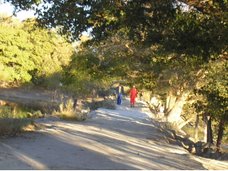
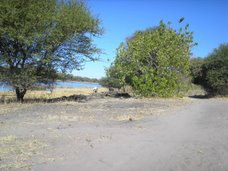
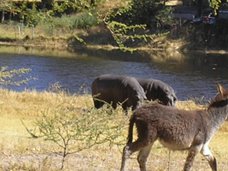
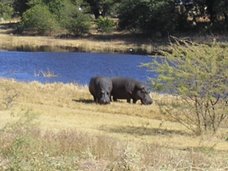
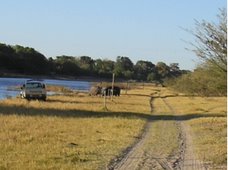
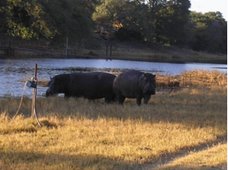
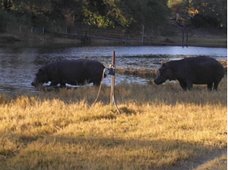
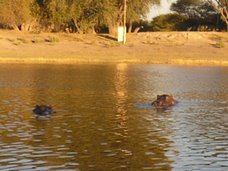
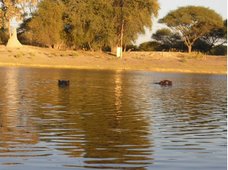
There is an epilogue to the tale of the Hippo's standing beside the path on Monday evening. This morning I decided to walk into town (26/06/07). Who do you think I should meet in exactly the same spot but the hippo's again. Today it didn't cross my mind to retrace my steps to the small makorro and cross to the Sedia bank, walk up to Big Tree and get a combie into town. I just decided it was time to explore a bush path arouind the hippos.
Sorry folks, I've just realised that I have been putting an apostrophe on hippo when writing about hippopotami. That must have been so annoying for you. Shaln't do it again.
So, I slowly veered left onto the soft sand and into the thorny protection of the bush. Taking one very carful twig avoiding pace at a time I proceeded towards but awat from the hippos. As I drew level with them voices on the opposite bank began to bid me HELLO & GOOD MORNING at the tops of their lungs. It was the soldiers from the Barracks on the opposite bank at the end of their pier shouting encouragement (wether to me or the hippos I'm not sure, I reckon watching someone getting chased through the thorny bush by a playful and curious hippo would be a nice diversion fro barrack-room monotony).
The fact that I am writing from Riley's and not Maun General Hospital wildlife maimings ward this is eveidence that the hippos had had a heavy breakfast and were in no mood for play as I gently made my way past them.
Work Experience
Where am I now?
I'm still in Maun, of course. I'm just beginning my third week here and I've just begun taking cases on my own. Last week I was alternating with Julia. Having her there to discuss case analysis and remedies with me made things a lot easier, it felt a lot less pressurised than thinking alone.
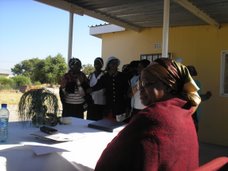
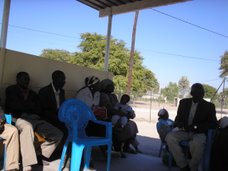
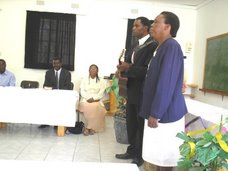
Since I arrived we've been working at a reasonable pace and our days have been varied for one reason or another. As you'll see from the photo's, last Monday we were invited to Boseja Kgotla to explain what the project is about. Usually we are at the Lutheran Church Clinic on a Monday from 0800 - 1600 with an hour for lunch. That afternoon we could go home early as noone had come to clinic that afternoon.
Tuesday's we're at WoMen Against in the morning and seeing private patients in the afternoon. That's a very different kettle of fish altogether as we do not have to use the Maun Homoeopathy project triad method. You'll have read about that in the post above this. I'm going to try and fix it so that My postings run chronologically from oldest at the top to most recent at the bottom. It doesn't make sense, the way it is now.
Wenesdays we do home Visits for Lutheran Church Clinic Patients and Thursday's were back at the Lutheran Church Clinic all day. Friday is always varied as we go on a thrice weekly rotation to Boseja Kgotla Clinic, Maun Conselling Clinic or Sennonori, which is run by the woman who comes each week to sweep our yard and do our washing. A good example of the blurred boundaries we are always warned about!
Tell Us About The Triad
OK. The triad ought to be fairly easy for most homoeopaths to understand as it seems to be based on Eizayagers 'Layers Method'. However, rather than treating each layer of the case sepparately we prescribe concurrently. At present i'm not quite sure of how the Triad came to be used. I feel a bit of an idiot because of that. Why didn't I bother asking? Hmmm.
I'm still in Maun, of course. I'm just beginning my third week here and I've just begun taking cases on my own. Last week I was alternating with Julia. Having her there to discuss case analysis and remedies with me made things a lot easier, it felt a lot less pressurised than thinking alone.
Since I arrived we've been working at a reasonable pace and our days have been varied for one reason or another. As you'll see from the photo's, last Monday we were invited to Boseja Kgotla to explain what the project is about. Usually we are at the Lutheran Church Clinic on a Monday from 0800 - 1600 with an hour for lunch. That afternoon we could go home early as noone had come to clinic that afternoon.
Tuesday's we're at WoMen Against in the morning and seeing private patients in the afternoon. That's a very different kettle of fish altogether as we do not have to use the Maun Homoeopathy project triad method. You'll have read about that in the post above this. I'm going to try and fix it so that My postings run chronologically from oldest at the top to most recent at the bottom. It doesn't make sense, the way it is now.
Wenesdays we do home Visits for Lutheran Church Clinic Patients and Thursday's were back at the Lutheran Church Clinic all day. Friday is always varied as we go on a thrice weekly rotation to Boseja Kgotla Clinic, Maun Conselling Clinic or Sennonori, which is run by the woman who comes each week to sweep our yard and do our washing. A good example of the blurred boundaries we are always warned about!
Tell Us About The Triad
OK. The triad ought to be fairly easy for most homoeopaths to understand as it seems to be based on Eizayagers 'Layers Method'. However, rather than treating each layer of the case sepparately we prescribe concurrently. At present i'm not quite sure of how the Triad came to be used. I feel a bit of an idiot because of that. Why didn't I bother asking? Hmmm.
So, I'll tell you about what I know about the triad method so far and what my experience is of it, so far. My opinions are bound to change as I have only been here two weeks so far (today is Tuesady 26th of June) and I have not been in touch with Hilary to get an idea of how the method developed. Anyone reading this from top to botom will read my most recent insights first.
The Triad Layers
The Triad Layers are - 1) Acute; 2) Constitutional; 3) Miasmatic.
At present I'm finding this method a little unwieldy, mainly because very few people we see have acute illnesses, their symptoms are long standing. Because of this I could understand prescribing a remedy for the chronic illness and another for the miasm but having to work in a third seems to me to be a bit of a contrivance.
But, we have to prescribe this way as Hilary wants to see the results of long term Triad prescribing. Things probably wouldn't be so rigid but for characters like me turning up and saying 'I'm not prescribing like that!' and doing their own thing. Luckily for the project I am not in a rebellious mood and I am happy to follow the protocol and see where it takes me
So that I feel happpy using the Triad method I've worked out a few ways of justifying to myself why 3 remedies are being prescribed.
My idea of how to Prescribe for "Acute" Layer = 1) remedy for totality of an acute miasm or exacerbation of chronic disease; 2, As a support for acute mental emotional states if Px has chronic symptoms.
Constitutional Layer: Patterns of Health / Ill Health & Menatal Emotional Reactions.
Miasm: Can an appropriate miasmatic link be made between acute and chronic symptoms? Which miasm is most obvious in the case?
And it feels even better prescribing this way if the remedies used can be related. Still, at present I'd feel less of a headache using just one or two remedies at a time.
So that I feel happpy using the Triad method I've worked out a few ways of justifying to myself why 3 remedies are being prescribed.
My idea of how to Prescribe for "Acute" Layer = 1) remedy for totality of an acute miasm or exacerbation of chronic disease; 2, As a support for acute mental emotional states if Px has chronic symptoms.
Constitutional Layer: Patterns of Health / Ill Health & Menatal Emotional Reactions.
Miasm: Can an appropriate miasmatic link be made between acute and chronic symptoms? Which miasm is most obvious in the case?
And it feels even better prescribing this way if the remedies used can be related. Still, at present I'd feel less of a headache using just one or two remedies at a time.
Monday, June 11, 2007
What was your first day at work like?
It began early at 6 o'clock and it felt earlier as it was still dark. Luckily it was probably the warmest morning Maun hashad for a few weeks, otherwise it would have been freezing.
Weha to be up early as Hilary, who set up the projct 5 years ago, was flying home and was giving a talk to the district health workers about the role of the project at 07.30! We drove through the scrubby brush jungle from our cottage on the bank of the river as the sun wa rising.
As it was my first day I was sitting in with Julia who has worked on the project before.About half the patients we saw needed an interpreter. This was a new and interesting experience for me but I didn't feel it detracted from the quality of the consultation. The rapport is built up between the patient and practitioner. The interpreter passes information betwen them. Of course, the interpreters have been trained not to rephrase what patients say or colour the information they relay with their own opinion. Altogether, I think this system works well.
This was only my first day and I'm going totell you more about what it's like to run a consultation through an interpreter but I was favourably impressed. I don't know what anyone else was tinkng but I recall that while I was studying I was getting theimpresion that the consultation room is a very fragile and sacred space and he slightest 'bad vibe' could upset the whole dynamic of the relationship between patient and practitioner.
It is and it isn't. The consultation and consulting rooms, likepatients are individual, fragile and sacred things which must be approached with humility and the right intention. At the same time, like people they are flexible, adaptable and resilient.
The consultation is made up of two components, patient and practitionr, 3 in Maun if you include an interpreter. When these components are comfortable in the space, wherever it's location, whatever it's shape or size the cosultation will work. Do all the components feel happy? Do they agree to be in the space? Do they know what's going to happen? Yes? OK, carry on, it will work. That's the key.
I'll tell you more about my discoveries in my next thrilling installment of 123 Homoeopathy!
Sunday, June 10, 2007
Maun Sounds Like A Fun Place To Be / मौन सौन्ड्स लिके आ फुं प्लेस तो बे
Drums thundered and waists shook as feet stomped the ground in dance at the freedom square in Sedie, Maun, over the weekend। The dust rose up in the air as a means of appeasing the Mbungu Wa Kathimana ancient gods to welcome and cleanse Botswana National Front (BNF) leader Otsweletse Moupo and his party from the misfortunes that are threatening to tear it apart.
And believe it or not, the cultural cleansing rites seem to have worked, as the sky suddenly turned cloudy and the soft breeze cooled the hot weather.
And believe it or not, the cultural cleansing rites seem to have worked, as the sky suddenly turned cloudy and the soft breeze cooled the hot weather.
I found these on Mmengi Online. Mmegi is published by Dikgang Publishing Company (DPC). The newspaper was established in 1984. Mmegi is the only daily independent newspaper in Botswana. The newspaper is read by a cross-section of the population including students, policy makers, intellectuals and the business community. Over the past 10 years Mmegi won the prestigious Institute of Bankers “Newspaper of the year Award” nine times.
Bats terrorise Maun Civil Servants
NOMSA NDLOVU
CORRESPONDENT MAUN:
An invasion by an army of bats has chased civil servants in Komane village, 26km west of Maun, out of their houses to seek accommodation elsewhere. Councillor Morolong Mosimanyane of Komane ward brought the matter to the attention of the Minister of Environment, Wildlife and Tourism Kitso Mokaila last week and said the bats have been terrorising the village since 2004.
He said that the bats use ceilings as their abode and the most affected houses are those of the teachers, nurses, and local police officers. Morolong told Mokaila that wildlife officers should be sent to deal with the bats. He said if wildlife officers had not prevented them, the residents would have long used other means to wipe out the animals.
"When we reported the matter, your officers instructed that we should not kill the creatures because they are a protected species. They said the only thing we should do is to remove them and patch the ceiling, but we tried and failed. Therefore I request you to send your officers to remove them from our area because we are tired of the anguish that they are causing us," he said.
Morolong explained that the animals are inactive by day but at night they come out of their hiding places and trouble residents. Their noises prevent the civil servants and their families from sleeping and cause panic. The occupants of the houses were then forced to move out and seek accommodation elsewhere. The problem affects most villagers with modern houses.
Morolong told Mmegi that besides the noises, the bats defecate and urinate constantly, causing a pungent smell and resistant stains on clothes, walls and the ceiling.
He said that the bats use ceilings as their abode and the most affected houses are those of the teachers, nurses, and local police officers. Morolong told Mokaila that wildlife officers should be sent to deal with the bats. He said if wildlife officers had not prevented them, the residents would have long used other means to wipe out the animals.
"When we reported the matter, your officers instructed that we should not kill the creatures because they are a protected species. They said the only thing we should do is to remove them and patch the ceiling, but we tried and failed. Therefore I request you to send your officers to remove them from our area because we are tired of the anguish that they are causing us," he said.
Morolong explained that the animals are inactive by day but at night they come out of their hiding places and trouble residents. Their noises prevent the civil servants and their families from sleeping and cause panic. The occupants of the houses were then forced to move out and seek accommodation elsewhere. The problem affects most villagers with modern houses.
Morolong told Mmegi that besides the noises, the bats defecate and urinate constantly, causing a pungent smell and resistant stains on clothes, walls and the ceiling.
What's Maun Like? / वहत इस मौन लिके?
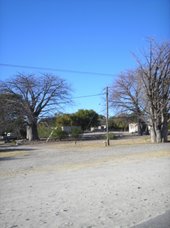
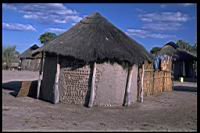
What's Maun like? Widely spaced and dusty. But I can see that there is a lot to explore. I saw my first Boabab trees from the road about 50k outside of town. That made me feel as though I was nearing journeys end. the countryside is broad and flat. There are small settlements dotted around with compounds of thatthced rond-houses and square rond houses also thatthed and more modern style houses. Cows, donkeys and goats occasionally break the monotony of a long straight highway by crossing it, making the bus perform a loooooong slooow down which precipitates a flash flood of shoes bottles and small luggage forward beneath the seats.
I arrived in Maun yesterday evening. We passed the school on theway in. Lads appeared to be playing rugby on a dustbowl of a pitch. There was a big crowd of spectators and the teams wore blue and green. I imagined anyone on that pitch would beabout 2kg heavier when they finnished from all the dust theye'd swallow and breathe in.
I notice sign posts directing me to places that I had heard of from my induction in London. Now I am here I really see how spread out maun is. I'll try and have some images for you next time i write. I'll also be able to tell you about my first day at work.
Stay tuned!
First Day In Maun / फर्स्ट दय इन मौन
I've just arrived in Maun. I spent my first night in Botswana at the splendid Boiketlo Lodge in Gaborone. It's really well placed opposite the Bank and Telecom ofices. There's a driving school 'office' under a tree outside the back gate which faces the Telecom & Bank. The driving school itself consists of an obstacle course of orange cones on a patch ofground beside the road a little further along. A man was entertaining the instructiors singing to a guitar. This was another good introduction to Botswana.
Mr. Moipolai says that Lonely Planet has got it wrong about his guest house. They describe it as 'noisy' apparently. He wasn't happy about that. The edition I read quite rated the place, which is why I chose it. It's certainly not noisy. So any of you with an old edition of Lonely Planet which describes Boiketlo Lodge as noisy, you'd better update it and say that it is clean, well appointed and quiet with a delicate perfume of woodsmoke on the evening air.
Mr Moipolai says that LP perhaps mistook the natural exuberance of Motswana for irritating noise. We are jolly people, we always greet, domella ma! Domella rra! You will see it when you get the bus, we are always greeting.
I was looking forward to a bit of this as things had been pretty quiet I thought. Everyone on the Mainliner kept themselves to themselves and everyone I'd seen in Gabborone deported themselves with the utmost decorum.
This changed I am happy to say, when I reached the bus station. It was as bright, noisy, ramshackle and full of human life as I had expected.Busses heave in and out, their touts roam the area shouting their destinations. People laden with great tarten laundry bags of luggage surge back and forth, with politeness and decorum. Vendors hawk fruit, mouth watering packets of chicken and chips made by Hungry Lion & Cicken Licken, chicken pies by Pie Perfect, Cold water, frozen into ice, Iron Brew, sweeties in buckets, wallets, passport covers & pocket-books, The Voice, The Botswana Guardian, pencils, plastic doccument wallets, air time for mobile phones.
The bus slowly fills up with passengers and vendors pass on and off like salts through a cell.There's always space to squeeze by and everything passes off with the utmost tact and decorum. There's some banter between passengers and vendors but everyone kepps themselves to themselves and are decorous.
Dr. Scientist
As we pull out of the bus station we pass more vendors stalls and food spots. Then, at one corner I see a crowd of people cathered round a larger shack. Inside is a sound system beside which sits a man with a really curious peice of woodwork in his hands.
It looks as though he is holding an instrument madefrom planks and 2 by four, held together with bolts. He's advertised as Dr. Scientist. There's a pile of compact discs on the sound system and a hand printed T shirt swings above them. He's tuning up to play that gorgeous rippling African guitar music. Notes and phases sparkle out and hit you in the heart. I'm straining my ears backwards as we pass away listening to the stretche d notes through the doppler effect. Resolved: I will track down and buy a copy of Dr. Scientist's CD when i return to Gaborone.
Thursday, May 31, 2007
Maun Homeopathy Project
It's about time I told you something about the Maun Homeopathy Project. I've cut and pasted this from the MHP website to give you an idea of what the MHP is about. I'll tell you more from my experience once the adventures of Rowland in Africa have truly begun.
At present I'm Rowland in London, gradually folding and filing the garments and articles of my existence here before I pack my bags and go. I'll tell you more about how I came to join MHP in a future post. Until then here's the introductory page to MHP's website...
The Maun Homeopathy Project Healing for Strength and Survival
MHP is a registered charity (No. 1109958) founded by Hilary Fairclough and Philippa Brewster in 2002:
- Establishing a permanent and free homeopathic service for women, men and children living with HIV and AIDS and/or traumatised by rape in Maun, Botswana
- working in partnership with agencies in the local community
- offering holistic care to people suffering from illness, trauma, grief and stigma
- travelling light with a mobile clinic providing an outreach service for those most in need
- to recruit and support local people to train in homeopathy to an internationally recognised standard
A Community in Crisis
Since 2002, The Maun Homeopathy Clinic has been running free homeopathy outreach clinics in Maun, a fast growing town in the north of Botswana, (click here to view map) where over 35% of the people are infected with HIV or AIDS, one of the highest rates in the world.
The epidemic has put this hitherto strong and confident democratic country into crisis and the Maun community like the rest of the country is suffering as a result. Everyone is affected and trying to cope with its daily devastating effects.
Maun is now the centre for the provision of medical and social care for people affected by HIV and traumatised by rape living in the town and its surrounding areas, but more help and other approaches are desperately needed.
Homeopathy fills the gap for a holistic approach to healing which is complementary to the existing and stretched medical and counselling services.Click Here for more on HIV and AIDS in Botswana
How can you help?
Make a regular donation by standing order; make a one off donation - Click to Donate now!Join our email list for news of fundraising events and for the MHP Newsletter - Contact Us
Our logo: The Baobab Tree
One of the great symbols of Africa, the Baobab Tree symbolises Strength, Survival and Longevity and all parts of the tree have nutritional and medicinal value.
Subscribe to:
Posts (Atom)