Friday, February 15, 2008

BBCi Removes All References To Complementary Therapies

You may not be aware that last week the controllers of BBCHealth (www.bbc.co.uk/health) , the health section on one of the most accessed websites in the world, decided to remove all coverage of complementary medicine!

They used to have substantial coverage with over 40 pages on this subject covering all the major therapies, their pros and cons, evidence for their effectiveness, how to find a qualified practitioner, etc.

However the site has in recent months been targeted by the self-appointed 'Quackbusters', (scientists and medics vehemently opposed to complementary therapies such as Prof David Colquhon et al) who sent a deluge of letters and emails claiming that complementary therapies such as homeopathy and cranial osteopathy were 'unscientific' and should be removed. As a result large chunks of this part of the site were simply removed overnight and now, following recent cutbacks, it was decided that, rather than update this part of the site, it should simply be removed altogether!

It may seem incredible that a public service site this prominent can deem complementary medicine so insignificant that it no longer warrants any coverage other than the odd news story. This is despite the fact that complementary medicine is used favourably by a significant proportion of the population (recent surveys have estimated that around 1 in 5 Britons use it at some point or other) and that increasing numbers of people are now seeking to train in these therapies.

However, as the 'quack busters' become more organised and active, evidence of the backlash against complementary medicine is appearing all over the place - such as the removal of NHS Trust funding for homeopathy, the threatened closure of the homeopathic hospitals, many negative news stories in the press and so on. Rather than taking a reasoned view and considering the evidence from good research studies on complementary medicine these individuals seem simply hell bent on trying to 'stamp out' complementary medicine in any way possible. The BBCi removal of complementary medicine coverage (which has been in place for almost 15 years!) is one example.

If you care about complementary medicine and believe information pages on it should be returned to BBCi, please, please take just a minute to express your views using their online comment form at:

http://www.bbc.co.uk/feedback/

to make your view known. As a public service company they have to listen to your views so your email will make a difference. Apparently for all the many letters and emails that they received that were against complementary medicine they only received a handful in support. Therefore if you are in support please let them know so they may revise their thinking on this subject.

Please act as soon as possible and pass on these details to anyone else you know who may also be willing to write in support of complementary medicine.


If you have found homoeopathy beneficial you can support a campaign to promote homoeopathy by visiting http://www.homeopathyworkedforme.org/ .


Thank you!

Thursday, February 07, 2008

Martin Miles Obituary

Martin Miles, homoeopath and the founder of The Society Of Homeopaths died recently. You can read his book of condolences at this address.

http://www.homeopathy-soh.org/about-the-society-/founder.aspx

Martin Miles FSHom 29/08/1947 – 27/09/2007

Martin Miles taught that homeopathy can create shining spirits. He was a man of modesty, a man who helped countless people with severe pathology, a man who inspired a love of homeopathy, a man with many friends and no enemies.

He started in practice in 1976, and with others in 1978 set up the College of Homeopathy and the Society of Homeopaths of which he was the first chair. Martin was a quiet yet humorous man - deep thinking, generous, a little mysterious, almost as if steeped in another time. It seems as if this was born out of his extraordinary introduction to homoeopathy through Thomas Maughan who regarded Martin as his amanuensis. Thomas had more or less saved his life by giving him not just remedial treatment but also a discipline and a focus. Their relationship was very much one of master and apprentice and this is how Martin saw homoeopathy being carried forward into the future. He always adhered to the belief that homeopathy should not only be taught, but had to be absorbed through witnessing others at work.

Martin originated from the East End of London where his father had been a travel agent, which was Martin’s occupation when he became involved in homeopathy. Maughan had studied homeopathy probably in the tradition of Clarke, Burnett, Cooper, and later Wheeler and Kenyon. Maughan taught a homeopathy class in South East London which Martin attended, and which Martin then taught for many years after Maughan’s death.

Martin took his Jewish roots very seriously, yet he was remarkably eclectic in his choice of philosophies to plunder for inspiration. He was fascinated by and very knowledgeable about ancient Egypt. He was one of the first to strongly advocate understanding of the chakras as a means to forming a prescribing strategy. His idiosyncratic methodology was, despite apparent complexity, remarkably simple: always support the patient where he is weakest or most vulnerable even while prescribing the indicated remedy. Thus and by dint of his great knowledge of remedy relationships, he developed multi-aspect prescriptions by which his patients received what Martin always regarded as the minimum: the indicated remedy, chakra support and drainage. He is also to be credited with consistently preaching and practising the frequent prescribing of the nosodes to support constitutional treatment, a legacy of Maughan’s.

In the early 1990s, he formed the Guild of Homeopaths with Janice Micaleff and Colin Griffiths. For a period of ten years, from 1992, the Guild engaged in a systematic programme of provings of new remedies directed toward supporting existing remedies, the endocrine system, and subtle anatomy. Martin was a leader of the Guild graduate course.

To have known Martin as a friend was good, but to have known him as a homeopathic colleague was special. His working life was unique; he turned the work of prescribing homeopathically into an art. He so obviously found homeopathy creative and fulfilling. How he practised homeopathy was unlike anybody else, and those of us who have learnt from him and think of ourselves as erstwhile apprentices, are aware of his achievement of stretching the boundaries of homeopathy a little further in order to cater for all the vastly increased ills that we are asked to consider nowadays. He was fearless in the clinic, unbridled in his contempt for the worst excesses of conventional science, prepared to take responsibility for prescribing in any situation. Yet he always insisted that the great prescribers of the past should be revered as truth-seekers: Hahnemann, Hering, Compton-Burnett, Cooper, Clarke and others, not least Thomas Maughan.
He continued in his thriving practice in the Blackheath and Bexley areas of south east London and teaching in the UK and overseas right until he became ill. He had been married twice and is survived by his three children, Alistair, James and Sarah.

Publications:
1994 Homeopathy and Human Evolution Winter Press.
1998 Interview with Martin Miles, The American Homeopath

This obituary was composed by Francis Treuherz FSHom with the help of Colin Griffiths RSHom and Jerome Whitney.

Websites Supporting Homoeopathy / वेबसाइट्स सुप्पोर्तिंग होमेओप्ति

After you've had a look at H:MC21 website you can look at these others which also support homoeopathy.

http://woowooscienc e.com/

http://freetochoose health.wordpress .com/

http://laughingmyso cksoff.wordpress .com/

Has Homoeopathy Worked For You? / हस होमोएओपथ्य् वोर्केद फॉर यू ?

Has homoeopathy worked for you?

Maybe you're familiar with the controversial research article in Lancet that found homoeopathy to have no effect in clinical trials. Whether the article was biased or not, there's enough people (and animals) in the world who have benefitted from homoeopathic treatment. If you are one of them you can add your voice to a campaign which promotes homoeopathy at the H:MC21 website.

Please note that H:MC21 is a non-profit-making organisation in the process of applying for charity status.

H:MC21 – Homeopathy: Medicine of the 21st Century
For details see www.hmc21.org


With as little as £5 you can help us make the
‘Homeopathy worked for me’ campaign successful

Dear Colleagues and Friends

Thank you for signing our declaration, and for your interest in our work. At the time of writing this message – and after five weeks of mainly word-of-mouth campaigning - we have already collected over 3,500 signatures.

But we need over 1,000 a day in order achieve our target of 250,000. We have some exciting projects planned to do this, but at the moment we have no money to fund them.

So, we are now turning to you all to donate whatever you can afford. This is our all chance to make history and put homeopathy back on the medical map where it truly belongs.

Please donate whatever you can: £5, £10, £100 or even more.

We do not yet have an online donation facility, but are working on it. In the meantime, please send cheques, made payable to H:MC21, to

The Treasurer
H:MC21
The Old Farmhouse
37 Filgrave, Bucks MK16 9ET

Or make a bank transfer to

H:MC21
at Abbey, Account No. 43159698, Sort Code 09-06-66

बेन गोल्दाक्रे, बुस्तेद ! / Ben Goldacre, Busted !

In a November posting you can read part of a response by Jeanette Winterson to an article in The Guardian by Ben Goldacre. Niow you can find out a little more about who Ben Goldacre is and who he works for.

AGANST DR BEN GOLDACRE

Cultural Dwarfs and Junk Journalism is Martin Walker’s fourth book charting the development of the corporate science lobby that has grown rapidly since New Labour came to power in 1997. One of the most recent exponents of the Lobby is Dr Ben Goldacre who has regurgitated a bad ‘Science’ column in the Guardian newspaper since 2003. Like other quackbusters Goldacre claims to write factually based and scientifically accurate articles about health, medicine and science either supporting scientists and doctors or criticising individuals involved in alternative or nutritional health care. Goldacre’s writing, however, actually reflects the ideology of powerful industrial, technological and political vested interests.Goldacre who it is claimed is a Junior doctor working in a London NHS hospital is actually a clinical researcher working at the centre of New Labour’s Orwellian spin operation that puts a sympathetic gloss on anything shown to create adverse reactions from MMR to Wi-Fi, while at the same time undermining cost-effective and long tried alternative therapies such as acupuncture and homoeopathy.

Goldacre is involved with public health researchers well known for trying to prove that those who claim to be adversely affected by pollutants in our modern high-technology society, suffer from ‘false illness beliefs’.Cultural Dwarfs and Junk Journalism, investigates Goldacre’s role in industry lobby groups and puts another point of view in defense of some of the people whom he has attacked, belittled, satirized, castigated, vilified, maligned and opined against in his junk journalism.

* * *Cultural Dwarfs and Junk Journalism: Ben Goldacre, quackbusters and corporate science, is available from the Slingshot Publications web site as a free download, from mid-day on Wednesday January 2nd. To be effective as a campaigning document, it is important that this book is distributed far and wide as quickly as possible. Please forward this publication information together with the Slingshot Publications web site address. Another thing that will help with the book’s distribution is the writing of even very short reviews for different web sites, this helps get the book onto Google listings.

This book is free and can be downloaded from the Slingshot Publications site: www.slingshotpublications.com. Please distribute it as widely as possible and if you think that the work is worth it, consider making a small donation. Also on the Slingshot site, is Martin Walker’s last book, The Fate of a Good Man. The book tells the story of Jim Wright, the investigation into him, his prosecution and trial by the Big Pharma regulatory agency, the MHRA. A good read at £5.00

Childhood Immunisations

Threatened support group needs more help / थ्रेअतेनेद सुप्पोर्ट ग्रुप नीड्स मोरे हेल्प

As homeopathic practitioners you are very likely to be asked on numerous occasions about your views on the subject of vaccination. I know some of you do encourage your patients to contact the Informed Parent, which is greatly appreciated, but after fifteen years of existence we are in danger of folding due to a lack of subscribers. So I’m appealing for support to help boost numbers which will not only keep the Informed Parent flourishing but also create an opportunity to widen its services.

It all began back in 1988. As a first time mum, it didn't even cross my mind to look into the issue of vaccination. Instead I diligently reported to my surgery with my new baby daughter for all of the vaccinations that were due. I don't think any parent likes to take their baby to be vaccinated because there is an instinctive feeling that you are betraying your baby's trust by handing them over to a stranger, who then proceeds to stick a needle into their thigh, unexpectedly - and most babies do cry at that moment! However it seems reasonable 'that a few moments of pain will mean a lifetime of protection.

It wasn't until my second daughter was coming up to 12 months old that I started to investigate this subject, which was triggered by a two-page article featured in the September 1991 issue of the London Evening Standard magazine entitled: Vaccination-The Hidden Facts. After reading it I began to wade through a great deal of literature, attend lectures, discuss the subject with various medical and scientific researchers and other concerned and well-informed parents. This led me to being one of the founder members of The Informed Parent which was initially set up in September 1992. The other three founder members, Janet Smith, Kim Harrington and Melany Still, were all mothers who had researched the subject prior to giving birth and all had chosen not to have their babies vaccinated. Our main aim was to encourage the public to inform and educate themselves on the vaccination issue before making their decision. However, by late 1994, the other founder members were unable to offer further involvement due to their family commitments and so I found myself in the position of either going it alone or 'shutting up shop' on the project!

Well, I decided that I had to continue spreading the word, as my passion for the subject was strong and I would have found it very difficult to walk away from it. During the 1990s, the Informed Parent had some publicity through the media and a few opportunities to be involved in TV and radio coverage, but in recent years it has become very rare indeed. Political correctness seems to have eradicated almost all debate or challenge on the subject leading to a growing number of parents completely unaware of any alternative avenues to investigate. Also, I believe that the vast amount of information now available on the internet has also had an impact on the falling

I am presently looking at ways to not only help save the Informed Parent but to expand and develop what is offered.

I would welcome any feedback or suggestions that may improve the service offered. The annual subscription is only £15 which entitles you to three newsletters; a 12-page resource pamphlet listing book titles, websites and useful contacts relating to vaccination; and other useful information leaflets. Homeopaths subscribing up until the end of February 2008 will be sent two extra back issues in the first mail out.

The established view on vaccination is very well protected, and it is hailed as one of modern orthodox medicine's greatest achievements. And yet there is much research which casts doubt on some of the claims made and I strongly believe parents should be made aware of this before making a decision on whether to vaccinate their children. It is about information and choice.


To subscribe please send your contact details along with payment to: The Informed Parent (Hom Special Offer), P O Box 4481 , Worthing, West Sussex , BN11 2WH. Or for more information phone 01903 212969 or check out the website at:
www.informedparent.co.uk

Wednesday, November 14, 2007

IN DEFENCE OF HOMEOPATHY

This article was written by Jeanette Winterson and published in the Guardian. I read the article to which she refers when it was brought to my attention at the case study group I attend. Here I've taken the liberty of cutting and pasting some of Jeanette Winterson's response. You can read the rest by following the link at the end . . .


In defence of homeopathyJeanette WintersonTuesday November 13, 2007The Guardian

Picture this. I am staying in a remote cottage in Cornwall without a car. I have a temperature of 102, spots on my throat, delirium, and a book to finish writing. My desperate publisher suggests I call Hilary Fairclough, a homeopath who has practices in London and Penzance. She sends round a remedy called Lachesis, made from snake venom. Four hours later I have no symptoms whatsoever.

Dramatic stuff, and enough to convince me that while it might use snake venom, homeopathy is no snake oil designed for gullible hypochrondriacs. Right now, though, a fierce debate is raging between those, like me, who trust homeopathy because it works for them, and those who call it shamanistic claptrap, without clinical proof or any scientific base.

There have been a number of articles in the press recently criticising homeopathic remedies as worthless at best, and potentially lethal at worst, if they are being taken instead of tried-and-tested conventional medicines for conditions such as malaria or HIV.
I have found myself cited, and drawn into this, because I am on record as supporting homeopathic practice in general, and in particular the Maun homeopathy project, a clinic in Botswana set up by Fairclough.


http://www.guardian.co.uk/g2/story/0,,2209998,00.html

Follow the link to the full article.

ROWLAND AT HOME

Hello again. It's been a long time since I last wrote. I've since returned from Botswana and returned to practice in London. I'll tell you about what adventures I have here in the coming months and my reflections on Botswana.

Sunday, August 26, 2007

Journey To Ubuntu, The Spirit Of The Ancestors

Gentle readers, this may be my last written from Botswana as I am due to leave next Sunday to resume my practice in London. I’m sad to be leaving as I am just beginning to get to know this little part of this great country and excited at the same time as I ‘ll be travelling back down to Johannesburg by bus and so have time to see some more new things on my way home.

We’ve had another wonderful weekend as we traveled south west, past Sehitwa down to D’Quae Q’Are to the Kuru San dance festival. Once again we took to the road with the remarkable Marty who pointed out to us the Thamalakawe fault along which our river runs and the ancient shores and sand-bars of paeleo Lake Ngami.

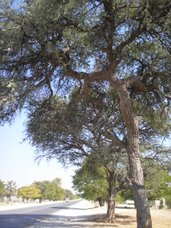
We saw some very fascinating things concerning ubuntu, the heritage of the ancestors, the ancient and contemporary landscape and Botswana’s delicate relationship with water. As we left Maun and and passed the Hereo village Marty began to describe the intricacies of Ngamiland’s subteranean waters. Lake Ngami has been dry for about 160 years. Sehitwa is situated on it’s shores and on the map appears next to a large expanse of blue. However, in reality the best you could expect to see was a few muddy pools. The most striking evidence of the absence of this water is the dead Lead wood and acacia trees. These trees are incredibly slow growing and those of any reasonable size are likely to be around 150 years old. Along the road as we passed out of Maun we could see a great many of these trees recently dead indicating that there is gradually less and less water flowing underground.

Further on we came to a great Baobab tree. Again, in this desert region these trees are incredibly slow growing and the one we saw could be up to 2000 years old. It’s smooth bark felt like stone and in it’s branches were growing it’s furry fruit. Marty pointed out to us a square outline on it’s trunk. This scar showed where people had stripped the bark in order to make cloth at least 300 years ago. This remonds me of the artefact we found when we gathered wood on the way back from seeing the waters of the Boteti flow again.

So, there we are, just off the old Samedupi road colllecting firewood when we come across a bleached white piece of timber, deeply weathered, about 1.5 meters long with grooves about it’s circumfirence. So we brought it back with us to figure out what it might be. Batsamai had the answer. It was a tool in the tanning and leatherworking trade and would have been suspended from a tree by ropes running around the grooves. Now, this piece of wood was leadwood, which used to be used for cart axles because of it’s durability. This piece was bleached white and deeply grooved along it’s grain so that although it had been worked it looked like an outer covering of leadwood bark. Forr the wood to have aged so much it must have been at least 200 years old. A piece of wood with so many stories to tell because it would have heard the ancerstors talking as they worked and then lay and watched as the cattle drivers passed with their herds, as woodgatherers passed and seen the old Samedupi road being built.

So, on we went and saw to our delight a much younger baobab growing beside the road and acacia’s beginning to put out yellow blossoms here and there. I got my first sight of real live wild ostriches. A pair of females were pecking beside the road apparently oblivious to passing cars.

On and on and up and over the edge of the Thamalakawe fault, through the vet fence at Kuke where we were in two minds whether or not to head off to the central Kalahari game reserve as it was relatively nearby but we’d set our hearts on going to the festival so on we went. Along a long gently curving road bounded by acacias and leadwoods. No Mophane trees though. There’s a Mophane line just southwest of Maun beyond which no Mophane grow.

We found D’Quae Q’Are and were searched at the gate for alcohol. During the festival no alcohol is allowed on site as it pollures the vibe for anyone likely to go into a trance while they dance. Smoking is forbidden at the dancing arena for this reason too.
We drove along a straight but bumpy track through the game reserve where the event was being held. We were passed by Ian Khama, the Vice President’s entourage going in the opposite direction and a bus full of schoolchildren who shouted ‘I love you’ and made Marty’s day as we passed each other.

I’d love to be able to describe the dances to you in great detail but it has been a long day. One of the most striking things about the dance groups is the role of the men and women. The women clap and sing and go out and dance in two’s and threes. They are accompanied by up to three men. One carrying a stick, one a fly whisk and one both stick and flywhisk. They provide a contrapuncta lrythmn of their own by stamping their feet in and shaking the belts of seeds which are wound round their legs. Men dance differently from women too, they are generally bent at the waist with their shoulders hunched and their elbows out looking awkward but dancing gracefully. For the women there’s more freedom of movement, they look more relaxed without their shoulders hunched.The other thing which struck me was the range of ages and costumes. One group were particularly striking as there were dressed in contamporary clothes. They struck me because it brought home to me the reality of the San people’s lives. Their no longer the pure, simple bushman characterized in ‘The Gods Must Be Crazy’ but fully paid up members of the twentieth centuary albiet with a unique culture and heritage.
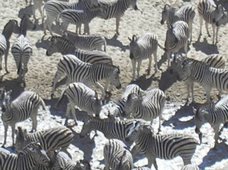
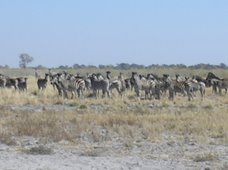
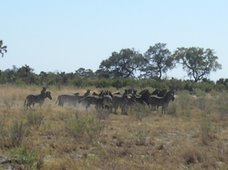
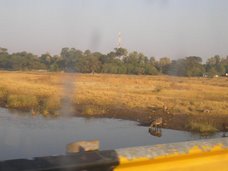
Suffice to say, everyone was enjoying themselves.It was a place for people from all over to meet up and rekindle aquaintances and catch up on gossip, buy tasty food, look at something and generally hang out in a festive atmosphere. Hey, I saw my fisrt Hartebeest there too. They were having a party too with a couple of Zebra and a wildebeest. Hartebeest look like elegant wildebeest. Where wildebeest are grey and shaggy hartebeest are golden and clean lined and the males have impressive slowly spiraling and curved horns. They have a similarly long face to the wildebeest and theirs is accentuated by a black line running down the middle of their faces from forehead to nose making them appear like masked animals.

I’ll put up some pictures from this trip and scenes from Maun and our trip top Boteti in the coming days. We’ve actually been pretty busy in the last couple of weeks and I’ve just been enjoying the opportunity to relax after work,. So sorry for the absence of pictures recently. Things aren’t going to slow down either. We’ll be in Shorobe on Wednesday and Friday next week to attend a convention of all the local HIV support groups., That’s going to be very interesting and a lot of fun too though I guess I will have left Botswana by the time I have time to tell you guys about it. Until then, take it easy.

Friday, August 17, 2007

Exploring With Marty: The Return Of The River

Today we went for a trip into the bush with Marty. We were keeping her company while she looked for holes in the cattle fence lining the Maun-Francistown road. This is one of those things that was put up by Central govern,ment with the best intentions but does not really work in practice.

Here’s the reasons why. The fence is sparsely gated and a gate only works when it is closed. Most of the gate-posts we passed were ungated as gates are very useful to people elsewhere. Those gates we did see were either left open or mangled beyond repair. Long stretches of the fence were non existent for one reason or another. In many places the fence had been trampled down by either people or animals and ceased to serve it’s purpose.

Why is this such a problem? The fence is there to stop cattle and other livestock getting onto the road and being squashed. When there’s no fence the cattle get out and graze along the sides of the road as there is very good grasss there. So Marty’s involved with getting the fence repaired etc. We drove out of Maun at half eight this morning and traveled along the road playing a sort of Eye-Spy car game for sections of fence which was non existent, bent and climbable, gated and closed, gated but with no gate, gated with an open gate and gated with a mangled gate. We did pretty well.

This journey brought us to the turning for Samedupi so we went down there to see whether any water had reached the bridge. We were travelling through fully rural Africa . We’d left the builders merchants, car spares shops, garages, take-away’s and liquor rests way behind us on the outskirts of Maun.

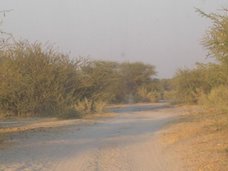
The way was lined with species of acacia, sage brush, mophane and mogotho trees. Every now and then we’d see compounds with one or two ntlo or rondavel houses, a big tree for shade and people going about their business. We’d pass donkey carts laden with containers for water and usually a couple of boys or an old man at the controls.

At Samedupi we got the first happy surprise of the day. Water had begun to flow in the Boteti river, a thing not seen for at least 20 years. It has been left in standing pools near Makalamabedi higher up the river in years prdeviously but had never flowed as far as Samedupi in about 20 years.

At the bridge it was coursing along like a mill-race and Marty pointed out that it was deep because the silcrete outcrops were submerged! Silcrete appears to be a little understoodmineral which forms somehow along rivers. It appears in stratified or nodular outcrops depending on how it was formed and can look like tree branches, trunks or rootrs which have become fossilised. The bits I saw reminded me a lot of the type of flint nodes which we found on Har Karkom when I was working with Professor Emanuel Anati’s yearly expedition there to catalogue the rock art. After all the Negev had once been a sea, and then had lakes and rivers. Thinking along those lines I asked Marty if she’d ever come across anything like the bulbusim you can find in the Negev and she had but much smaller and had at first mistaken hem for bolas stones.

We met a couple of local men on the bridge who were delighted with it and who pointed out fish to us. You could see on either bank people filling water and nearby work was going on on a pipeline. Marty found an acheulean hand axe on the bank, highly patinated. What marks these hand axes out is that they are shaped and pressure flaked before they are struck from the core.

We then continued on to Makamalabedi. Makamalabedi is a really pretty village. All the compounds are very neat and tidy looking and there are often well tended plants in them. Many of the traditional ntlo houses were decorated and had the traditional lowapa, a low wall creating a smaller space in front of the door. The veterinary fence that we passed through on our way to Meno A Kwena extends through here also and we had to pass the checkpoint. The friendly policeman there told us where we could get down to the river and so we went through the village and down there.

On our way we met a family in their Sunday best on their way to church and asked them when the river had arrived and it was only last night. We could see on the banks many people enjoying themselves. Children were splashing around as women and girls came and went with water containers. And everyone was very happy and you can understand why if you live in a desert next to a river which possibly hasn’t flowed in your lifetime.

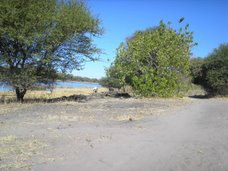
We decided we’d carry on and see if we could find the leading edge of the river creping forward across the dusty earth. We went off the tarmac road and hugged the river banks. Along here were great molapo fields reacing almost from he crest of the bank down into the middle of the river beds. These are fields marked out by fences made from piles of acacia branches and saplings. They are quite an ingenious sort of agiculture. The idea is that you build your field and wait for he river to rise. Once the river has risen intoyour field you’re OK. Then as the water retreats you plant your crops and they are rooted well as trheir roots follow the retreating river water.

Down in the river beds we could see smaller area’s fenced off like this which were wells people had dug to reach the ground water. We had lunch in the shade of a tree high and dry up on the bank. Afterwards I went to look for scorpions in amongst the silcrete rocks on the river bed and scout a possible route back to the leading edge of the river through the field of spiky silcrete. What I found was the pelvic bones of a cow still joined at the symphysis and making a great mask for a sangoma. I took it back to where we were all sitting and Marty claimed it in the name of her grand-children.

I forgot to mention that on our way we’d lost sight of the river and when we came back to it it was dry as it ever was. Marty who can read landscapes like you can read the letters of this blog explained why. We could see that the river curved back to where we had last seen it and this curve was caused by the river having to edge round a large formation of silcrete below the topsoil.

OK, you’re up to speed now. So after lunch we continued back along the riverbank towards Makalamabedi weaving down to the river bed, up the bank and from one side of the riverbed to the other and passing molapo fields and wells along the way. Makalamabedi came back into sight above the river on the far bank then we emerged from the bush and saw a backie parked and a cluster of people so we headed towards them. The backie turned out to belong to Water Affairs and we’d found the leading edge of the river being very dramatic.

The river had found itself a nice narrow channel to creep along around the edge of the silcrete deposit. It had just arrived at the lip of a well dug in the river bed and the men from water affairs had broken the lip to allow the water into the well and replenish the groundwater. The water poured over the edge in a healthy torrent and to the delightof us and the onlookers swiftly filled the well and spilled over the edge and began to flow forward through the parched grass like so many glistening snakes.
So, how is it that a river which has been dry for 20 years suddenly return to life? The reason is good rains in Angola . One of the men from water Affairs told us that the waters were continuing to rise in the panhandle, i.e. the point of entry iof water to the Okavango Delta in northwestern Botswana.The river was a beautiful thing to see flowing through the desert, reflecting the blue of the sky and glittering invitingly through the trees. Just looking at it you can feel its coolness and really appreciate its importance, here in the desert as a source of life. This was something which I had never seen before, a river in the desert returning to life and I was sharing this amazement with the people who lived here some of whom had never seen the Boteti river flow in their lives. I may not see such a thing ever again in my life.

Birdie Time

5 PM is birdie time here in the garden at Disaneng. Like clockwork Red-Eyed Bulbuls and a lot of other birds which I can’t identify descend on the garden and splash around in the bath. There’s also a gang of bold, raucus voiced ‘cheeky-birds’ who hop, hop hop around and investigate aywhere. They’ll hop into the kitchen and if you surprise them there they’l go into hysterics and fly around like crazy looking for a way out. Best thing to do is open a window and leave them alone to find their own way out .

Friday Night Pub Quiz At Matshwane School

We had another foray into Maun soiety last night at a super-pub-quiz at Matshwane school. We went there with Hilary, she actually paid for half of our entrance as there was a deficit of two people on her table. We were seated with Anna-Lise who runs the gym and played Little Nell in the charity show production of Rocky Horror Show. There were four other people plus Hilary, Me, Anna, Helen & Lutz. Helen was an ex-park ranger from Southwark and Lutz was a really chucklesome pilot.

The table next to us were beefy Afrikaans pirates, some people came in fancy dress. They made a reall noise but were very funny and good fun. There was easily a hundred people in the great hall and like all Maun social events became a little too much of a good thing towards the end. But let me tell you what the good things were. Fun was the biggest good thi ng. There were hoots and cat-calls and local in jokes while the questions were being asked. The Dominatrix from the Maun charity concert was in charge of questions and crowd control. She’d done her best to make herself look like Ane Robinson of Weakest Link fame but in attitude she made Anne look like a drowned pussy-cat.

Then there was the food, provided by the schools Indian contingent. They had prepared a succulent chicken curry with REAL ROTI that was one of the highlights for me. Then there was meeting people. Anna-Lise is good fun but she was way down the other end of the table. I also met a woman who had surprised me that lunch time by saying hello to me in Hilary’s. She was one of those people who look dreadfully familiar but one can’t place. Anyway, she was very nice and very pleased to know that there were homoeopaths in Maun. Lutz was a funny guy and most of what we said to one another resulted in laughter on both sides. Karaoke was also a good thing. Instead of questions, one segment was singing. We all had to sing as a team. It’s Not Unusual by the inimitable Tom Jones was our song and I am pleased to say that Anne and I gave a good account of ourselves on backing vocals. But consider, 8 tables taking about 5 minutes each to get to the front and get their song set up and then sing about 2 minutes of it. Christ, it went on for almost an hour! The good thing was, the tunes were all danceable so that’s what was done.

By the time the winners had been announced, raffles drawn, other prizes handed our etc. It was one o’clock AM. And still there had to be the disco! Most people left including us as Hilary had taken us there and was heading home. The usual hard core of troublemakers stayed and with a regretful backward glance we left.

Thursday, August 09, 2007

A KUDU REVEALS HIS DEATH

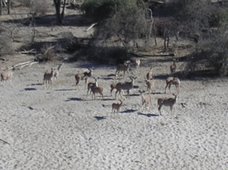
I recently visited the game reserve to see the giraffes. As I entered the bush I saw a big Kudu buck and decided to follow him whither he would lead.

I would get just to the edge of his comfort zone and off he'd go, kicking his heels up and disapearing into the trees and sage brush and I'd continue in the same general direction and get glimpses of him ahead of me before he charged off again. This went on for about an hour until I emerged into a clearing and there he was on the other side striking a classic pose with his body in profile and his face towards me displaying a remarkable pair of spiral horns and bigpink funnel-like ears. The early morning sunlight was slanting down through the branches and creating a wonderful wilderness scene. By a miracle he stood still long enough for me to take a photograph of him before he skipped off again.

He gave a hop skip and a jump and appeared to disappear into a hole behind some bushes. Curious, I thought, and walked as quietly as possible over there. As I got closer I could see the Kudu lying on the ground. At first I thought I had surprised him taking a dust bath and he was playing dead, but no. This was a reall dead Kudu.

I had to say thanks to the Kudu for letting me have his photograph and letting me get this close to a real wild African animal and share his space. I could have touched him if I had wanted to but I thought it was best to let him have his last moments in peace.

As I slowly left the clearing pondering on what fate led me to see a Kudu, a real , live , wild African animal keel over and die of old age like that, I almost walked into a young Girraffe, minding his own business and quietly chewing the cud.

He was kind enough to let me draw his body, couldn't fit his head on the page! I've some picasso-esque sketches of his head though which he kept moving around. I saw three giraffes in all, one a mature female who galloped in silent slow motion into the trees! They're incredibly beautiful animals. And when they run, even with trees, bushes and branches all around there is absolute silence, it's like watching a dream!

Sunday, August 05, 2007

Rowland's African Day

I had a really African day on Saturday. For the first time in a long while I’vefelt as though I’m actually in Africa. In recent days we’ve been becoming busier and busier in and out of clinics and except for a visit to Hilary’s house we’ve just been working, doing admin to keep things running and going home.

However, things changed for me on Saturday when I had a bit of an odyssey. Saturday was the day Noah was meant to visit and check our poor weak backie out and see what was wrong with it and put it right. Anne elected to stay behind and wait for him as she was sick and tired of driving our sick and tired backie around. So I went in to town.

My first stop was at the barbers. I had intended tosee the guy again who Alex had reccomended at airport junction but he was not around so I walked up to Old Mall as there is a profusion of barbers shelters there.

The day was bright and the air was cool as I walked into town as it was not yet ten o’clock. It’s a nice feeling to walk along roads which you normally drive down in the heat of midday, full of traffic between one appointment or another and these roads are quiet and the traffic moves slowly.

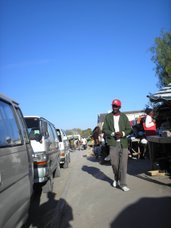
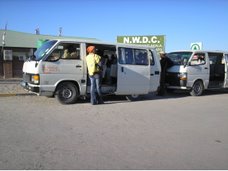
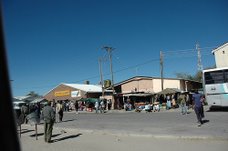
As usual there were crowds of people and vehicles outside shoprite, combies still jostled for position at the rank and the soundsystem still played fluid rythmic tunes into the air but I had time to take it in. The bright light forces you to squint and this narrows your field of vision to a space immediately in front of you and the environment is felt rather than seen until you reach a patch of shade and can widen your vision and take things in.

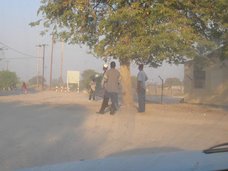
You can see big built Batswana middle class families coming and going at shoprite in big 4X4’s, tiny barefoot children with tinier siblings stand in groups intent on childish things, there are young women getting their hair braided in the shade of trees and awnings, phone credit hawkers in yellow vests break away from the crowds at the bus station like free electrons from the nucleus of an atom, flash youths in baseball caps, polo shirts and ripped jeans prowl the mall, young guys stand in groups chatting, laughing, smoking shouting out to their friends passing in cars, great stately Hereo women in brightly colored cloth sailing through the dust and crowds, gents in dark two-piece suits, collar and tie wearing stinge brim trilby’s looking like CIA men.

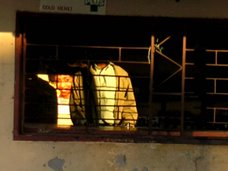
Like the Indian barber who practices his art on the street in the shade of a tree the barbers of Maun work in shacks made from planks and shade netting which provide a cool cave like shelter from the bustle of the street. Inside written in felt tip on the wall is the tarrif and below it are glued fragments of a mirror in which you can see your portrait as Picasso might have painted it.

You can choose an office cut, an English cut, a brush cut, a brush cut punk, or just a shave-no-style. Not knowing what to choose I asked the barber to make my hair short and smart and waited for the sesult.

Anne and I are hoping to include some barbers signs in the Sign Safari. They all appear to be in the same hand and include 3 heads which look like they are Batswana celebrities copied from films or newspapers. And, they all appear to advertise 3 styles, short, very short and shiny. I was fortunate and came away with a sort of Matt Gloss, which suited me fine.

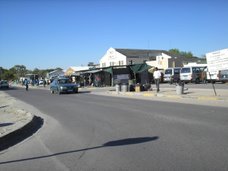
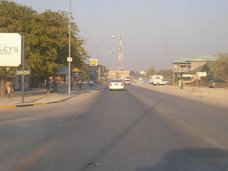
I then turned my footsteps down Tsheko Tsheko road, past Choppies another big supermarket on one side and the victorian looking general dealers, butchers shop and electrical dealers on the other, with it’s concrete arcade and cool, dim, cavernous shops entered by a single door and smelling of dust and dried goods. Down Tsheko Tsheko road (which means Court-Case Court-Case Road) to the 4 way junction and turned left at the Hereo settlement corner and headed down to the small bridge which would take me to the Francistown road.

On my way there I passed students in their blue uniforms, I was passed by a wedding party driving slowly and tooting, a group of singers in lime green shirtsand orange waistcoats belting out songs from the back of a backie and giving thumbs up to everyone they pass, donkeys drowsing by the side of the road, herds of apparently unacompanied goats coming upo the embankment beside the bridge, horses wading in the river nibbling reeds, young people looking as though they are waiting to meet other young people on the bridge and finally I turn right, onto the Francistown road.

The Francistown oad is long and straight and in the full heat of the day, I pass builders yards and garages and the take-away/liquor rests that we pass on our way back from the pool which look so lively and inviting in the light of a Saturday evening. Cars pull up and drive away, a few people hang around outside drinking soft drinks and talking into mobiles, huddles of people with there baggage stand in the dust in the shade waiting for the hourly Francistown combie.

I reach the Ubuntu Cellphone & Landline shop and remember that I’ve not year eaten breakfast. But first, a note on Ubuntu. What is Ubuntu, Mageu maize milk ‘Salutes the Spirit of Ubuntu’, a liqueur made from Morula trees is decorated with ‘Ubuntu Beads’. Mary tells me that Ubuntu, roughly translated means ‘ancestral spirit or the soirit of the ancestors or something very traditional.

I head for the second Take-Away/Liquor-Rest outside of Maun, the Boseja Take-Away. These places, like the general dealer and butchers I mentioned earlier have a victorian appearance, being a single storey L shaped block of a building with the roof coming down low over the walk in front of the stores and making an arcade. These are the parts of Maun that really give it it’s frontiers-town atmosphere. Again the stores inside are dim and quaint knocked together looking. The Boseja Take-Away consisted of a counter behind which stood three big coke and beer fridges, full of beer, coke, softdrinks and things to be kept cool. On the counter in a glass prism were bags of fresh doughnuts and sliced grubby looking bread (aside from Hilary’s home-made bread available in loaves from the coffee shop bread is in a pretty low stageof evolutin here) and plates of Chicken & Macaroni, Chicken & Rice, Chicken & Papa.

There was a hand drawn and decorated ‘halal’ sign over the kitchen door and the place was run by a smiling, friendly Indian man with big Indian hair and a moustache. He was very helpful in explaining the intricacies of his menu and so I chose the chicken and macaroni which was spiced up by a big blob of ketchup. As I dined I was able to appreciate the idiosyncracies of decoration within the Take-Away. The walls were a smoky orange and were overpainted with abstract unmistakeable tiger stripe patterns. What lent the place a disturbing quality was the addition of about 4 pairs of Tigers’ eyes peering through the jungle and looking hungrily at the customers as they ate their chicken.

MMMM! That filled a yawning chasm at my core and I set off bouyed by a healthy balance of spices, e-numbers, protein and carbohydrate for my weekend swim.

I had still further to walk before the giant watertower on stilts which marks Matshwane school appeared. I let myself in as there was no old deuteronomy guarding the gate and went to the pool. Walking round to the deep end the air felt warmer than usual. I steeled myself to dive into the icy night cooled waters and dived in. Yet, I was pleasantly surprised to find that the water wasn’t quite so cold and when I reached the other end of the pool I was even happier to find that I was withouth the urge to leap out of the pool, dry off and bake for the rest of the day. I lounged for a bit with my elbows on the side and enjoyed the contrast of the hot sun, warm breeze and now invitingly cold water.

I did 18 lengths in two sessions with a baking out period in between. I was once again pleasantly surprised at my stamina which I now, on reflection ascribe to the running I now do every other day. As I knew I had a long walk back into town and dinner at Marty’s at 6 I left at about 3.30 while the sun was still hot.

The problem now was how to get home with the greatest expedience without having to walk home the way we drive as it is a very very dusty road. The easiest way would be a combie to the big bridge and then walk down along the river. This is what happened and so I was able to enjoy a walk home along the river in the beautiful African afternoon light.

Check It Out!

Hey folks!
I can now put pictures in my text! Lets's see what appears in the future!

Friday, August 03, 2007

आ वाल्क ब्य थे रिवर / A Walk By The River

Hi Folks! All of a sudden the Hindi converter starts working again! Apologies to all my readers inHindi who have missed this in recent posts.


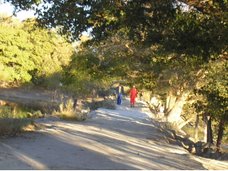
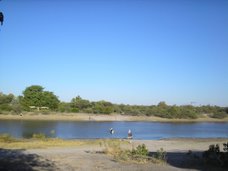
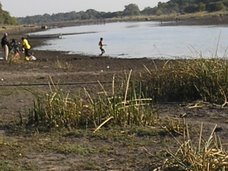
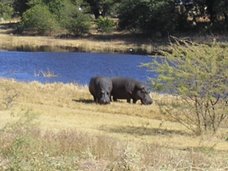
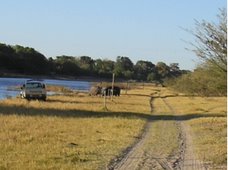
Here you see some pictures from a recent walk along the river bank and an exhibit from the Sign Safari। नमस्ते, हिंदी रेअदेर्स! वेल्कोमे बैक!हेरे यू सी सोम पिक्टुरेस फ्रॉम आ रेसन्त वाल्क अलोंग थे रिवर बैंक ऎंड अन लुठेरण चर्च थे ऎंड वी।


The sun is begining to linger longer in the sky in the evenings and the river is higher than ever and is a very beautiful place to be in the evening. This is good as our lives here are beoming busier by the minute. more and more patients are visiting us at the private clinic. This is good as the patients who pay to see us there help to support the free homoeopathy clinics we run at The Lutheran ChurchThursday is by far our busiest day. It is a full day at the Lutheran Church Clinic and we अरे now seeing around eight patients each। Patient numbers have been gradually creeping up on a Thursday and down on a Monday because people have begun to think that Thursday is our quiet day. So we've been asking our patients to come for their follow up visits on a Monday.

Wednesday is quite a hard day as it is the day we see our home visit patients. As I have said before these consultations are hard because the patients are very sick and bedridden. The consultation is haarder because you are in a room with a very sick person, their relatives our translator and another homoeopath. One can feel concerned about the expectations of the patient and their family, concerned about intruding into a persons home with a great caravan of people as well as trying to come to a decision about how to prescribe and handle the case.

You need a cool head to do this and it's not easy but thankfully our days were not so full as they are now when I first startred. This gave me the chance to understand our prescribing method and the dynamics of our various consultations. I feel comfortable now about involving the patients relatives and our interpreter in the consultation and using their input and insights into the case. It was something I did in the past as a matter of form but now it feels like a natural and comfortablepart of the consultation.

We've got a good protocul between us as homoeopaths, Anne and I which we organised when there were three of us including Julia. We go through the cases before the home visits to get an undertsanding of the cases and decide who will take the case and who will facilitate the prescription. This gives the prescribing homoeopaths two heads to think with and makes the vexed questions about remedies and potency easier to overcome if the case is difficult.
Still, it's a hard days work. Thankfully we get on well and take care of each other. We've both got experiences and insights to share and have a good laugh when we're not working. I'm glad to say we're a good team!
Thursday, July 26, 2007

Three Patients Sitting In The Sun.

Today (Wednesday 25th July) was one of our hardest working days। Wednesdays usually are as they are the days we do home visits। Home visits are hard work for several reasons. They require us driving over very rough and/or sandy roads and we often get stuck in the sand; Consultations are often taken outside patients houses in the yard in the heat of the sun; We see very weak and often bedridden patients; We see very severe physical pathology. On the plus side we meet very strong people.

The patients’ strength makes their condition all the more poignant as we meet very strong people who are imprisoned in their own bodies through weakness. You can hear their strength in their voices, see it in their eyes or hear it in their words and it makes them appear in a very pitiful and tortured state as they cannot fend for themselves or engage with the world at large any more.

Seeing this strength although saddening to see imprisoned in a bed makes me optimistic that the patient will in time recover and this week I’ve seen this strength win through.

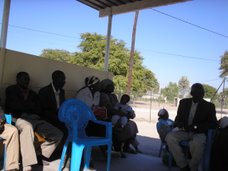
Today we were very happy to see three of our patients who were bedridden a week ago sitting outside in the sun. One was the albino patient I described in an earlier posting. Her first words when we met her were ‘I’m well!’. Her ulcers were clearly healing and she was very pleased to show us the progress they were making whereas at our previous visit shewas very weak and in a lot of pain and her ulcers were open wounds.

Our second patient had been in bed for months with diarrhoea and vomiting. Today she was sitting in her yard in the shade of a tree, proud to tell us that she could walk to her outhouse and back. Next time, she told us ‘You’ll see me cooking’.

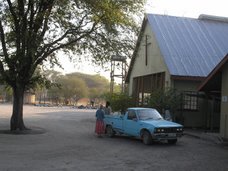
Our third patient had also had constant diarrhoea which was now improved. Like the other patients she was sitting in her yard in the sun with her mother, her daughter and her grandchildren who were all playing at ‘foreigners in a decrepit pick-up stuck in the sand’.

I’m not describing people rising from the dead here. In all three cases there is a long way to go before they are as healthy as they’d like to be but the fact that they are out of bed, have more physical comfort and energy than before and doing things they enjoy is a big step for them on the road to recovery.

I’m pleased to say that many of the patients I am seeing now are improving or are returning to homoeopathy after a long time of being well. I’m not saying that this is all down to my sudden appearance on the scene. It is more due to the strength which the patients themselves posess and the many other homoeopaths who have added their skill to the proces of recovery.

The Flexibility of The Triad Method.

It’s when there is a change in symptoms rather than an improvement after the first prescription that one can see the flexibility of the triad method. An easy example togive is the first case at a subsequent follow up.

***The patient did well on their first and second prescriptions but they have returned. Their joint pains have returned but they find that they are now worse at the end of the day when they are at rest. They have to keep moving to keep the pains at bay. They began again around the time their children were threatened with expulsion from school because they were late with school fees (Everyone has to pay school fees in Botswana whether government or private school). The patient became worried for their children's future and took on extra work. Nothing much else worries them aside from their families welfare and their responsibilities.

In this case the aetiology of the joint pains and their characteristic of being worse for rest and better for continued motion indicates not Bryonia but Rhus Tox. The patients underlying constitution and background remain unchanged so far so the prescription can be repeated with the Bryonia, the initial remedy for the patients joint symptoms being changed for Rhus. Tox. Calc and Carc can be repeated as before.

More Medicine of Experience.

I’d like to let you know more about the triad method and how I am using it in the treatment of patients with HIV. I described it in an earlier post as being like an often repeated single remedy. It is like that but it is also a subtle and flexible therapeutic intervention.

To make this easier I’ll give you an example of triad prescriptions for the sort of cases we often see. The cases given below are outline examples as a full case taking would be too much to present.

*** A patient has begun to get joint pains which are worse on motion and better for rest, these areaccompanied by a terrible headache which makes them just want to sit still and not be bothered by anybody. They naturally have become very bad tempered. Their focus in life is their home and family as they had to care for younger siblings and older relatives from an early age their parents died of cancer. They have recently had to cope with a bereavement and now care for another family members’ children. They take this responsibility very seriously. Their major worries are the pains which prevent them from working and this in turn makes them worry about how they will cope with their responsibilities.

After repertorisation the well indicated remedies include Bryonia, Cal.Carb. and Carcinosin. In this sort of case we would usually give each remedy one day apart in the appropriate potency for up 3 weeks Bryonia on Mondays, Calc. on Wednesdays and Carc. on Fridays.

Case 2

*** A patient is seen at home and they present with with diarrhoea accompanied by burning pains, respiratory difficulties, generalized physical pains at night and a very depresed state of mind. This has been continuing on and off for a long time but is now a chronic state and they are rapidly emaciating though they are trying to eat.

The well indicated remedies repertorise out as Ars. Alb.; Carbo.Veg.; and Syph.

As the condition is long standing and day by day worsens the patients health the remedies would be given over the course of a day in an appropriately low potency for a week.

In these hypothetical cases the patients show a good response at the follow up, they’re not completely cured but they’re much better than before.

So far so good. In these two cases the triad prescription has acted like a single remedy. There’s been a good reaction in the patient on all levels and the prescription can be repeated with confidence that it will continue the curative response in the patient.

The Dawning Of A New Era

The river is halfway up the tree trunk which marks the makorro stop behind our house. The river is high all along the banks. The landscaspe here is in constant flux. The new road being built has successive layers of surfasce put on it and levelled off. The tyre tracks on the dirt roads which have been carved in the land beside it, winding in and out of trees seem to develop and lose ruts and potholes by the day.

We’re entering a new and exciting phase here in Maun. It is only one third as exciting now as it was a week or two ago but it is still exciting. Initially Anne and I were to be responsible for setting up a new clinic in Sehitwa, 90K southwest of Maun on the shores of Lake Ngami. We were also given responsibility for re-energising the poorly attended Senonori Support Group Clinic and of re-establishing our relationship with Bana Ba Letsatsi which means children of the street and as you can see from it’s name is a charity for streetchildren and children orphaned by HIV.

Sehitwa and Senonori unfortunately had to be put on the back burner because of logistical difficulties. As Sehitwa is 90k away we would have had to have used a vehicle other than our backie which is in pretty poor condition because it has to cope with some pretty rough terrain and is driven by several different people each year who each have to get used to an antiquated backie and very rough roads. This problem was almost solved by a member of the Lutheran Church’s congragation offering to loan us a vehicle for the journey. The only problem was, they wanted us to pay for mileage/wear and tear to the vehicle at 3 pula per kilometer in addition to us paying for petrol.

Then there was the question of which day we should go. We’d all agreed that once a month was a good routine for a one day clinic at the Lutheran Church in Sehitwa. For the Sehitwa group Thursdays was a god day. For MHP Mondays were preferable. Because there were too many if’s and but’s this project has to beleft until we get a new vehicle in September.

Senonori is another pickle. The time before last when we visited we saw only one patient. We had a chat with Rosinah the Senonori Support Group leader and she suggested that it was due to people’s fear of being stigmatised that they didn’t come to see us. We had another discussion with Rosinah this week and she told us the following story. As well as people in the area being worried about becoming stigmatised if they are seen visiting the homoeopathic clinic there is also a problem with the support group itself with whom we work. I can’t be quite sure of what it is despite having spoken to Rosinah who is Senonori support Group’s founder. It has something to do with it not being registered with the regional council department which looks after support groups despite SSG having applied for registration 3 years ago. Rosinah tells me that in addition to a lack of local government support and the fear of stigma of it’s members there is also now a suspicion in the community that Maun Homeopathy Project is something to do with the local council and we are checking up on them.

We’d arranged with Rosinah on several occasions to speak at local Kgotla meetings but due to one cause or another they’ve not happened. So, we are to continue turning up at Senonori but not to expect much to happen.

So, like I said, due to the Senonori and Sehitwa projects being put on the shelf things are only one third as exciting as they appeared to be. We do still have Bana Ba Letsatsi to look forward to which we will begin in August.